
Worker of the Week is a series of blog posts which highlights the workers at H.M. Factory Gretna that our volunteers researched for The Miracle Workers Project. This project aimed to centralise all of the 30,000 people who worked at the factory during World War One and, although it may be over, our amazing research volunteers are continuing to uncover more stories about H.M. Factory Gretna workers to be added to this database. We are always looking to learn more about H.M. Factory Gretna workers. If you know anything about a H.M. Factory Gretna worker please feel free to get in touch with us by contacting info@devilsporridge.org.uk This week’s Worker of the Week is another sad one – George Henry Pike. Information supplied through Research Project led by Nigel Crompton. A huge thank you to him and as always another huge thank you goes to all our research volunteers!
Early Life
On 4th December 1882, George Henry Pike was born into the family Richard and Mary Ann Pike. His father was a police constable with the Devon Constabulary.
George had four siblings. We know that he definitely had two younger brothers, but the 1911 census seems to indicate another sibling who sadly did not survive.
According to the 1891 census, the family were living in East Budleigh in East Devon.
In 1898, Richard had now become a Sergeant. Unfortunately, he died in service.
Joining the Navy
Meanwhile, George had joined the Navy. His service record shows that he appears to have falsified his birth date by a year. Instead of his actual date of birth, 04/12/1882, George has given his birth date as 04/12/1881. We think he might have lied to join the Navy when he was younger than he should have! Unfortunately, we know such practices were far from unusual.
The 1901 census seems to have been taken while he aboard a ship on the night of Sunday 31st March 1901. George’s age at the date of his last birthday is listed as being 19 on the date of his last birthday and his birthplace as Dawlish, Devon. Interestingly, this is different to the birthplace of East Stonehouse, Plymouth listed on his birth registration in 1882! Could this have been a mistake made by George?
“Unfit for Service.”
After serving for some time, George was forced to leave the Navy in August 1901. His Naval service record provides the reason for this as “invalid.” We don’t know exactly how George was affected by this, but it is likely it could have been as a result of his time with the Navy.
By this time, George’s mother, Mary had moved to the Ellacombe area in Torquay. It seems that George may have stayed here for some time following leaving the Navy.
Although, no definitive entry has been found for George on the 1911 census, there is a George of the correct age working at the Torquay Corporation Waterworks. Admittedly, George is not the most unusual name, but we can’t help thinking that it would be an awfully big coincidence if another George of the same age living in the same area happened to be working here.
Either way, George was described as a store clerk in February 1916 when he tried to join the Devonshire Regiment in 1916. His address is still listed at Torquay at this point.
It seems he may have initially successfully managed to join as a reserve, but was quickly recommended for discharge. A note on his enlistment paper for the territorial forces “Recommended for discharge. Unfit for service.” Perhaps he was still affected by his injury from when he was discharged from the Navy?
In July 1916, only about 5 months after George joined the territorial force as reserve, he was discharged. His dismissal papers suggest the reason for this was once again, “being considered unfit for service.” They do not tell us exactly why this was found to be the case. However, from these papers we do learn that George was 5 feet 10 and a half inches tall with weak brown eyes and black hair. They also tell us that he had a tattoo on his right forearm which includes an anchor and a cross.
H.M. Factory Gretna
Perhaps, this frustration of being deemed “unfit” for service could have led him to resort to working at H.M. Factory Gretna, so he could still do his bit in the war effort. Both his brother’s served in World War One.
Although, we do not know exactly when George started working at Gretna, we can presume it was after he applied for the territorial force as his address is listed as Torquay on his papers. We do know that he lived at C 4 Eastriggs, during his time working at the factory and his clock in number was 25536. Interestingly, it is his Torquay address later listed on his birth certificate.
Unfortunately, accidents did happen at H.M. Factory Gretna, often with fatal consequences. In previous Worker of the Week blogs, we have remembered of Roberta Robertson and Frederick Arthur Bird who both died due to accidents at the factory. Making cordite at H.M. Factory Gretna could be very dangerous work and I will always believe those who risked there lives to work there were exceptionally brave people, even if not all of them may have truly realised the possible consequences of their actions.
A Fatal Explosion at H.M. Factory Gretna
On 12th March 1917, there was an explosion in the Broomhills section of H.M. Factory Gretna. There is not many details on what actually happened, but we do know that George is described as being an acid circulator at the factory.
This accident had fatal consequences. George died of shock and haemorrhage, because of the explosion.
He appears on the death register for the parish of Gretna in 1917, which described him as a 34 year old munitions worker at the time of his death. The address used his here is No. 9, Princes Street West, Ellacombe, Torquay rather than his one in Eastriggs.
A public enquiry was held for George alongside two other people who died. We know one of these, James Booth, also worked at H.M. Factory Gretna and sadly died in an unrelated accident. The conclusion of this was that there was not enough evidence to show what had caused the explosion or James Booth‘s accident.
George was laid to rest in Rigg Cemetery between Gretna and Eastriggs. His headstone was engraved “died in the works hospital of Eastriggs Munitions Works” and then underneath “erected by his companions and fellow workers as a token of respect and esteem.” It seems that even after his short time working at H.M. Factory Gretna he left a good impression and was well thought of by those who worked with him there.
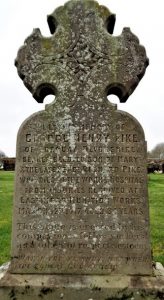
George Henry Pike’s grave in Rigg cemetery.
His mother Mary, emigrated to Canada to be with her two remaining sons and their families.
The Ministry of Munitions records indicate that £125 compensation was paid to George’s family plus £10 8s 6d in funeral expenses.
***
Read George Henry Pike’s online database entry by clicking here>
Do you have a relative who worked at H.M. Factory Gretna? We would love to hear from you! Please feel free to contact us by emailing info@devilsporridge.org.uk. You never know maybe your relative feature in a future Worker of the Week blog post! You can also have a look at some more H.M. Factory Gretna workers on our online database here>