

Worker of the Week is a series of blog posts which highlights the workers at H.M. Factory Gretna that our volunteers researched for The Miracle Workers Project. This project aimed to centralise all of the 30,000 people who worked at H.M. Factory Gretna during World War One and, although it may be over, our amazing research volunteers are continuing to uncover more stories about H.M. Factory Gretna workers to be added to this database. We are always looking to learn more about H.M. Factory Gretna workers. If you know anything about a H.M. Factory Gretna worker please feel free to get in touch with us by contacting info@devilsporridge.org.uk This week’s Worker of the Week is Alexander McKenzie Lupton, who took part in many concerts as a vocalist! A huge thank you, as always, to all our amazing research volunteers for helping to make this possible.
Early Life
Alexander was born on 22nd April 1872 in New Luce, Wigtown. He was born into the family Jane McKenzie and Robert Calvert Lupton.
His father, Robert worked as a parochial schoolmaster, inspector of poor and registrar. Accordingly, the family can be found living in a Schoolhouse in Inch, Wigtownshire in the 1871 census and appear still to be living here in 1881. We can safely assume that the families residence – where they lived for at least 10 years – may have been connected to Robert’s job.
Robert and Jane had a total of seven children, including Alexander, all born during their time living at the Schoolhouse. Sadly, not all of them survived infancy. Alexander would never have met his older sister Alexandrina Lupton, who was born in 1869 and died at the age of only 1 year old in 1870. There is a similarity in their names. Could Robert and Jane be honouring the memory of Alexandrina when they named Alexander?
Sadly, the youngest of Jane and Robert’s children, Robina Jane Lupton (born in 1877) died in 1879, aged only 1 year and 9 months old. Both Alexandria and Robina Jane are were buried at the Inch Old Churchyard in Wigtownshire.
By the 1891 census Alexander was living with his eldest sister Jessie Williamson Lupton (born in 1864) in Dundee. Jessie was a music teacher. During his time in Dundee, Alexander was a apprentice architect.
He had moved to live in Stirling to live with his eldest brother, Thomas Lupton (born in 1862) by the 1901 census. Thomas was a solicitor and Alexander is recorded as being an architect / measurer / surveyor and civil engineer.
Married Life
It was not long after this it seems that Alexander married Agnes Adam Ferguson (born in 1882) in Glasgow on 12th June 1903.
There first child was also born in 1903, but sadly died in 1904.
Agnes and Alexander had six more children (including some twins). After marriage they must have returned to Stirling, as this was were all 7 of their children were born. Perhaps, this was in part to be close to Alexander’s brother Thomas? Indeed one of the twins appears to have been named after him!

Alexander seems to have liked chess.
Hobbies and Interests
Alexander and his brother Thomas keen chess players. They both took part in the Scottish Chess Tournament in 1905. One of them even won the junior championship in that tournament! They both also took part another chess tournament, The Gentlemen’s Lightning Championship in 1908. So we think that the brother’s must have played plenty of chess games during there time in Sterling. We wonder who won the most often?
Chess was not Alexander’s only interest. According to The Great War Theatre’s website, there was an A.M. Lupton who was an engineer and well known in the amateur performance community in Stirling. [1] We think it’s more then likely that this A.M. Lupton could be Alexander McKenzie Lupton!
A.M. Lupton preformed “in concerts at the annual Royal Infirmary and a war fund benefit in Callander during May 1916,” according to The Great War Theatre’s website. [1] He is mentioned in several newspaper articles in the British Newspaper Archive as a vocalist in many different concerts. In one, Alexander is described as having a “full toned baritone voice.”
Indeed, it is Alexander’s interest in performance that led us to finding his connection to H.M. Factory Gretna. A newspaper article from the Stirling Observer in 1917 suggests that he is employed as a draughtsman at H.M. Factory Gretna for over a year. [3] As the article puts it:
“Mr A. M. Lupton so long a leading figure in local musical and dramatic circles. For over a year he has been employed as a draughtsman at the Gretna Munitions works”
– The Stirling Observer, 1st May 1917.
This suggests he must have been working at H.M. Factory Gretna from at least some time in 1916. We know munitions production had began at H.M. Factory Gretna in 1916, but could Lupton have worked at the factory before this? If he was working as a draughtsman, he could have been helping create technical drawings for factory building or equipment in some way. However, we have not found any other evidence of exactly when Alexander started work at Gretna.
However, we do know his interest in performance continued after he began working in the factory. He became a member of The Gretna Choral and Operatic Society [3]. In fact, it appears that he may have been one of it’s founding members. [1]
The Gretna Choral and Operatic Society
The Gretna Choral and Operatic Society was one of the many social and recreational activities that H.M. Factory Gretna workers could get involved with. The recreational activities available at the factory were seen as being an important way to keep workers happy and therefore more productive (it also helped to keep the munitions workers out of mischief, but we do have some accounts of thefts made by the factory workers all the same!).
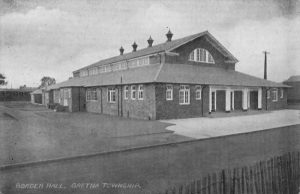
There was Social and Recreational Department which supervised all amusements and recreation facilities, which would have ranged from the tennis courts and the cinema, to perhaps even the factories women’s football teams like the Mossband Swifts! We know dances were held at The Border Hall in Gretna and this was also were The Gretna Choral and Operatic Society preformed.
In The Gretna Choral and Operatic Society’s first performance, Lupton was the stage manager and played Sir Joseph Porter, First Lord of the Admiralty. This was for a production of ‘HMS Pinafore‘ which was staged in The Border Hall in April 1917. [1]
This was the first of many performances from The Gretna Choral and Operatic Society in Gretna’s Border Hall. Including ‘Les Cloches de Cornville’ and ‘Paul Jones the Solway Mariner.’ [2]

Inside The Border Hall in Gretna where Alexander would have preformed with The Gretna Choral and Operatic Society.
However, decision to demobilise H.M. Factory Gretna (with demobilisation beginning on 6th December 1918) after the end of World War One, saw the start of the end for The Gretna Choral and Operatic Society and Lupton’s time with it. One last show was preformed at The Border Hall across several dates in early December 1918, with “special trains” put on locally for the show. [2] Factory Superintendent J C Burnham had silk version of the programme for this performance, which can be seen on display in The Devil’s Porridge Museum.
But what exactly was this last performance of? Well, it was of ‘The Gondoliers’ with “Mr A. M. Lupton” appearing at the head of the cast list in the programme as “The Duke of Plazo-Toro (a Grandee of Spain).”[2] Not only that, but it appears that Alexander was once again acting as the stage manager! His passion for theatrical performance and clearly hadn’t waned. Do you think his family ever came to watch his performances?
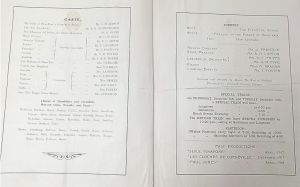
Inside of a paper programme from ‘The Gondoliers’ at The Border Hall in Gretna in 1918.
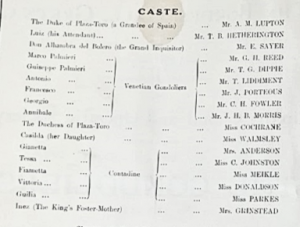
Mr A. M. Lupton appears at the top of the cast list in the programme.
‘The Gondoliers’ is about two brother Venetian gondoliers, who have just chosen brides, only to find out one of them is the royal heir to the kingdom of Barataria. If you fancy watching this performance, at the time of writing, there is a version of Gilbert and Sullivan’s The Gondoliers on BBC iPlayer (although, we must disclose that this is a more modern production the the one Alexander was involved in at the Border hall over 100 years ago!). You can find The Gondoliers on BBC iPlayer by clicking here>
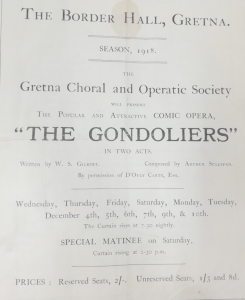
The front of The Gondoliers programme.
After H.M. Factory Gretna
And what happened to Alexander after his time at the factory? Was this his last performance?
Of course not! When he returned to Stirling he was involved in the Stirling Choral Society, the Stirling Operatic Society and the Kinross – shire Amateur Dramatic Society.
In 1920 Alexander was an architect involved in a new housing scheme in Bonnybridge, but that was not the only event which happened in his life that year. More excitingly The Falkirk Electric Theatre changed its name to the Empire Theatre and was leased to none other than Alexander! During his time leasing the theatre he presented numerous acts from Europe and America.
Unfortunately, the good news did not last long. Sadly in 1930 Agnes died.
We next come across Alexander in 1932 when he married Elizabeth Campbell Doig in Dunbartonshire. Perhaps in the future, census records will be released which could show more of what happened to the family in the years after Agnes’ death?
In 1946 Alexander died in Old Kilpatrick, Dunbartonshire. This could be seen to suggest that maybe Elizabeth and Alexander stayed in Dunbartonshire, at least following their marriage.
***
Sources and Further Reading
[2] Gretna Choral and Operatic Society, The Gondoliers programme, December 1918 from The Devil’s Porridge Museum’s archive.
[3] The Stirling Observer, 1st May 1917.
Read Alexander McKenzie Lupton’s online database entry>
Do you have a relative who worked at H.M. Factory Gretna? We would love to hear from you! Please feel free to contact us by emailing info@devilsporridge.org.uk. You never know maybe your relative feature in a future Worker of the Week blog post! You can also have a look at some more H.M. Factory Gretna workers on our online database here>