
Worker of the Week is a series of blog posts which highlights the workers at H.M. Factory Gretna that our volunteers researched for The Miracle Workers Project. This project aimed to centralise all of the 30,000 people who worked at Gretna during World War One and, although it may be over, our amazing research volunteers are continuing to uncover more stories about H.M. Factory Gretna workers to be added to this database. We are always looking to learn more about H.M. Factory Gretna workers. If you know anything about a H.M. Factory Gretna worker please feel free to get in touch with us by contacting info@devilsporridge.org.uk A huge thank you as always to our research volunteers.
This week’s Worker of the Week is John Benns, we think he was the manager in the stationary department at H.M. Factory Gretna.
Early Life
- John Benns was born on 30th November 1872.
- When he was born, John already had six older siblings.
- His parents were Robert Benns and Lydia Frances Bowness.
- Robert worked as a Corn Miller.
- Following this, census records indicate that 1891 John was working as a Stationer’s clerk.
Marriage
- After that, John married Ellen Eliza Rees in Woolwhich in 1901.
- By this point, John was working as a Commercial Stationer’s Traveller, as also indicated on the census records for 1901 and again in 1911.
- Additionally, We know that John and Ellen had two children.
Time at H.M. Factory Gretna
- Both John and Ellen are registered as living at 10 S West in Gretna in the Gretna Electoral Roll. [1]
- John’s occupation is given here simply as “manager”.[1]
(It is worth noting that Gretna, were John and Ellen lived was one of the two townships, with the other being Eastriggs built to house the influx of people who came to work at the factory. Despite it’s namesake with the largest of the two townships, Gretna, the rural site of the factory actually stretched from Longtown in England to Dornock in Scotland).
- However, this is not the only mention of John.
- He is mentioned in the Mossband Farewell magazine and described as working in the “Stationary Department” amongst some thank yous. [2]
- Accordingly, we think John could have been the manager of the stationary department at the factory.
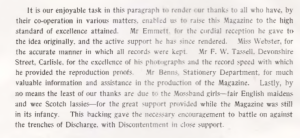
Mr Benns is mentioned on page six of The Mossband Farewell Magazine [2].
- The Mossband Farewell magazine was created by those who worked in the Mossband – or Longtown – section of the factory to commemorate their time working there.
- Similarly, The Dornok Farewell magazine was created by those who worked in the Dornock section of the factory.
- Although the factory rural site stretched 9-miles, Mossband and Dornock and were the two main sites with many of the buildings spread out to avoid chain-reactions from any possible explosions.
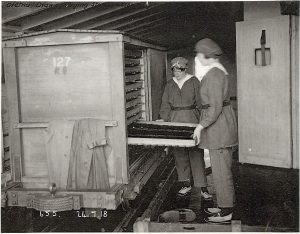
Two munitions workers at work in the the Mossband section of the factory.
- Additionally, you can find out more about the Mossband Farewell in a video from a online talk from 2021 on our YouTube. Watch the Mossband Farewell video by clicking here>
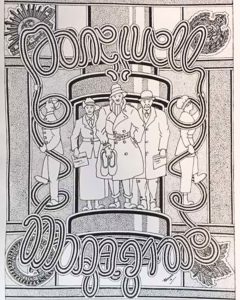
Illustration from The Mossband Farewell Magazine.
Life After Gretna
- Next, John appears to have worked as Stockbrokers’ cashier from what the 1939 census indicates.
- We know that John must have moved back to London at some point after his time at the factory, but we are yet to find out exactly when. If you know more please feel free to get in touch!
- On 7th October 1947, John died in London.
Sources and Further Information
[1] Page 323 (digital page 32), Parish of Gretna Electoral Roll 1918 to 1919. [2] Page 6, The Mossband Farewell Magazine from The Devil’s Porridge Museum’s Archive.
Find John Benns online database entry by clicking here>
Do you have a relative who worked at H.M. Factory Gretna? We would love to hear from you! Please feel free to contact us by emailing info@devilsporridge.org.uk. You never know, maybe your relative could feature in a future Worker of the Week blog post! If you would like to you can also have a look at some more H.M. Factory Gretna workers on our online database here>