
Worker of the Week is a series of blog posts which highlights the workers at H.M. Factory Gretna that our volunteers researched for The Miracle Workers Project. This project aimed to centralise all of the 30,000 people who worked at the factory during World War One and, although it may be over, our amazing research volunteers are continuing to uncover more stories about H.M. Factory Gretna workers to be added to this database. We are always looking to learn more about H.M. Factory Gretna workers. If you know anything about a H.M. Factory Gretna worker please feel free to get in touch with us by contacting info@devilsporridge.org.uk Thanks to everyone who makes this series possible including our awesome research volunteers.
This week’s Worker of the Week Robert Ray joining the factory was initially described as an “important appointment” in a Fife newspaper. Read more about what he did below.
Early Life
- On the 12th April 1889, Robert was born in Cellardyke, Fifeshire.
- His parents were Agnes Bonthone (nee Oliphant) and James Ray.
- We know James worked as a Clerk in Holy orders for the Church of Scotland.
- Robert had two brothers, Phillip and James Forrest (known as Forrest, perhaps so as not to be confused with his father).
- Later records suggest that Forrest had haemophillia, a genetic condition which means his blood takes longer to clot than usual and he would bleed more easily.
- According to the 1891 census, the family were still living in the same address as when Robert was born, which his The Manse in Cellardyke.
- At this time, James is a Minister of the Church of Scotland.
- Interestingly, the family were employing, 15 year old nurse, Betsy Paterson to look after Robert and had a cook / domestic servant, Annie Paterson. They do appear to be related.
- When the census was taken they had a Church of Scotland missionary, Adam Currie, visiting at the time of the census.
- Next, the 1901 census shows that the family are still at the same address.
- They also continue to employ a cook and nurse/ domestic servant, but these are different people to the ones who appeared on the last census record.
- By this point James is described as Minister of Cellardyke Parish.
- Meanwhile, the three boys are at school.
Studies
- After this, we think Robert studied at his local University at St Andrew’s.
- Here, he gained a Bsc.
- Seemingly Robert also achieved a F.L.S (Fellowship of the Royal Society) and F.R.S.S.C, the Scottish equivalent.
- Similarly, Philip studied for and passed “a degree of bachelor of science in engineering.”[2]
- Interestingly, for this the subjects he studied were “mathematics, natural philosophy, chemistry and physical laboratory.”[2]
- Could Robert have also studied these or similar subjects? What do you think?
Engineering and Zoology
- Following this, the 1911 census shows Robert was working as an engineer.
- He is found on the return census record for the SS Gibralter in The Alexandra Dock, Newport, Wales as the fourth engineer around this time.
- After this, it appears that Robert went to the University of Cape Town as a lecturer in Zoology in 1913.
- We have found further evidence of this on the ships passenger lists.
- According to these Robert sailed second class on the ship “Saxon” from Southampton to Cape Town on 16th August 1913.
- At this point he is described as a 24-year-old scientist, but by the return trip on “Llandovery Castle” from Cape Town to Plymouth, Robert is indeed described as a Lecturer in Zoology.
- This also shows us that his return trip was on 19th December 1915.
- During Robert’s time in Cape Town, we know that one of his brother’s Phillip was attested and posted to France.
- Initially, Phillip joined the 8th Battalion Black Watch (Royal Highlanders) but was later transferred to 59th Squadron Royal Flying Corps.
- Could Phillip being sent to France have influenced Robert’s return to Britain and his actions in 1916? We can’t know for sure, but what do you think?
H.M. Factory Gretna
- Shortly after his return, in early 1916, it seems that Robert showed signs of wishing to use his scientific skills to aid the war effort.
- Resultingly, from October 1916, he ended up working at H.M. Factory Gretna, or as explained as an “important appointment” in The East of Fife Record: [1]
“Mr Robert Ray, Bsc, F.L.S, F.R.S.S.A has been appointed chemist-in-charge of Hill 3 in Nitro-Glycerine Section of H.M. Factory at Gretna. Mr Ray offered his services as a chemist to the Ministry of Munitions early in the year and was at once accepted.”
– The East of Fife Record. [1]
- Unlike some of the other chemists who have worked at H.M. Factory Gretna, Robert seemed to volunteer his services directly rather than being redirected to work as a chemists.
- One notable example of this is Australian, Cyril Callister [3] who was re-directed from the Australian Imperial Force (although, this could be in part due to a scheme organised by Arthur Leighton Edgar for Australian chemists and engineers). [5]
- However, it seems the Ministry of Munitions rewarded Robert for this with some explosives experience, prior to his employment at H.M. Factory, as the article goes on to explain…
“In March he [Robert] went to the Government works at Waltham Abbey to gain experience of high explosives and after four months’ service he was transferred to Gretna, where he has seen new machinery installed and gained further experience in his work.”
– The East Fife Record. [1]
- While Robert was employed at the factory, Phillip was transferred to the Royal Flying Corps.
- Sadly, Phillip died during aerial action near Douai on 13th April 1917.
- He is remembered on the Arras Flying Services memorial.
- This would have been hard for the remaining two brothers.
- On the 10th November of that same year, Robert’s remaining brother, James Forrest (known of Forest) joined the Royal Air Force.
- Perhaps he could have been inspired by Phillip. What do you think?
Eastriggs
- Meanwhile, Robert might have been living at A4 Staff Quarters in Eastriggs.
- Or rather the 1918 to 1919 Valuation Roll lists a “Robert Rae” does, but we think this is probably actually Robert Ray. What do you think? Could a ‘y’ be mistaken for an ‘e’ on the valuation roll?
- According, to the “Institue of Chemistry 1918 Proceedings Part 1 – Register of New Students, Associates and Fellows” it could well be!
- Robert Ray appears among those listed on this record and his address is given as A4, Staff Quarters, Eastriggs, Dumfriesshire.

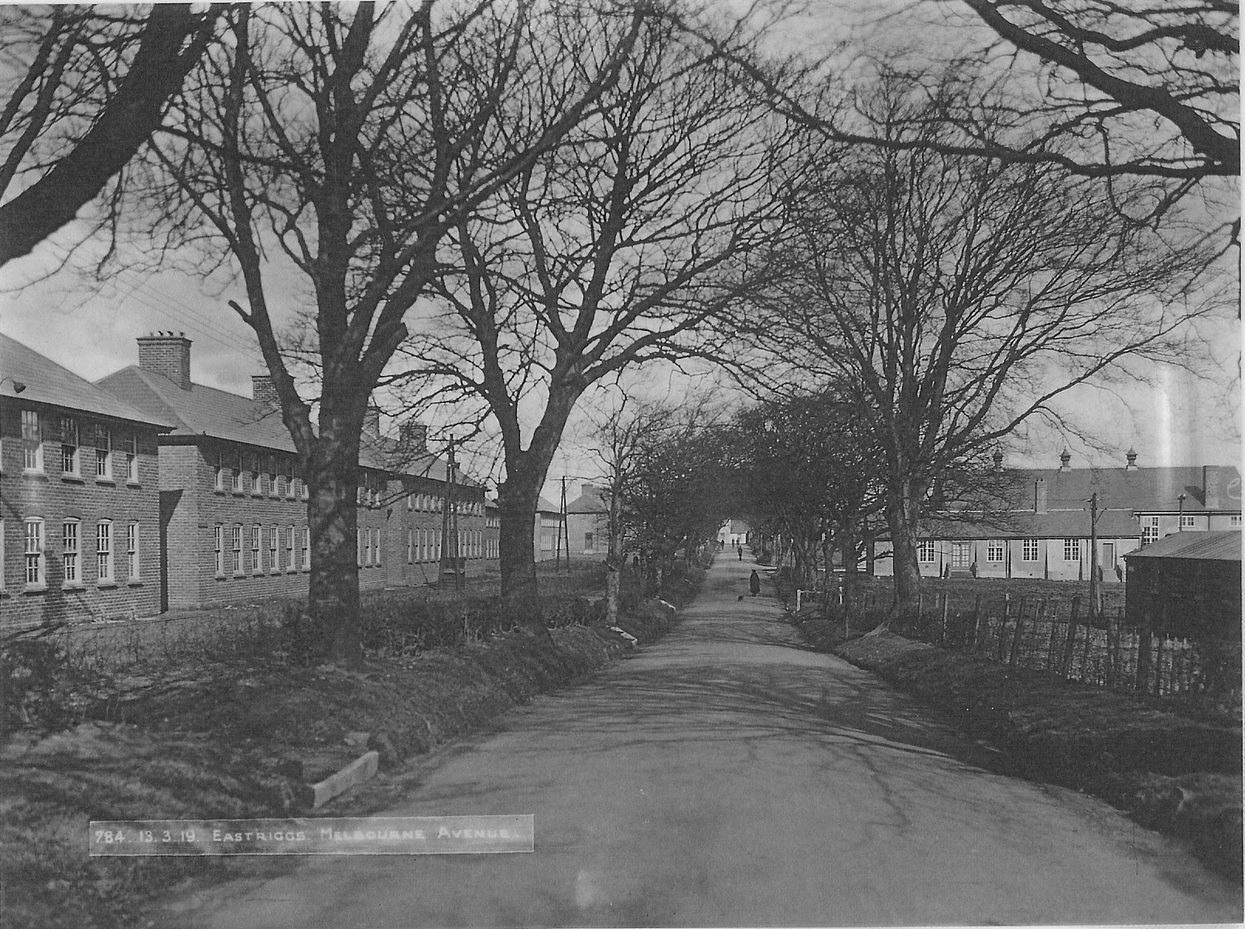
Do you think Robert Ray would recognise Eastriggs from this photo?
- Eastriggs was one of the two townships built for the factory site, (the other being Gretna) and the rural site of the actual factory stretched from Longtown in England to Dornock in Scotland.
Married Life
- Not long after Eastriggs, on 18th October 1919, we find Robert at his wedding.
- Robert Ray married Mary Marton at St Matthias Church, Richmond, Surrey.
- By this point Robert was an engineer, who had moved from Eastriggs to live at 5 Onslow Road, Richmond according to the marriage record.
Further Travels.
- It appears that Robert went on to travel for work.
- First, we come across him sailing to Buenos Aries as an engineer on 27th July 1928 with his home address given as 24 Carter Road, Sheffield.
- Then, later in that same year we have found evidence of Robert returning from Durban.
- Although, he is still an engineer, this time his address as given as Hollies, Chapleton, Sheffield.
- Sadly, the next record we have is the death of Robert’s remaining brother Forrest in May 1930.
- The cause of Forrest’s death is given as hoemophilla and he had been working as an Art Publishers Representive.
- We have found no further records of Forrest’s time in the royal air force, but do know he married.
- As Robert registered the death, it would be nice to think the brother’s remained close during their lives.
- Only three years later, Roberts father, James also died. [4]
- His mother Agnes lived until she was 95 years old in 1956.
- On a more happy note, Robert appears to have continued to travel, or at least his job title suggests he did. We wonder how many places he would have visited for his work?
- Indeed, the 1939 census describes Robert as a “Sales Engineer Travelling Technical.”
- Although, still living in Sheffield, Robert and Mary’s address was now at 76 Oakdale Road.
- Mary herself is on on unpaid domestic duties, but that’s not all!
- The record does add that she was an auxiliary nurse.
- Lastly, Robert died on 19th May 1964 in Sheffield.
Sources and Further Reading
- “Important Appointment,” The East of Fife Record Newspaper, Thursday 26th October 1916.
- Local news section, The East of Fife Record Newspaper, 1917.
- Worker of the Week: Cyril Callister – https://www.devilsporridge.org.uk/cyrilcallister
- The Scotsman Newspaper, 13th June 1933.
- Anticipating Tomorrow’s Defence Needs – A century of Australian Defence Science by Peter Donovan published 2007 by The defence Science and Technology Organisation, Canberra, Australia.
Find Robert Ray’s online database entry by clicking here>
Do you have a relative who worked at H.M. Factory Gretna? We would love to hear from you! Please feel free to contact us by emailing info@devilsporridge.org.uk. You never know maybe your relative could feature in a future Worker of the Week blog post! You can also have a look at some more H.M. Factory Gretna workers on our online database here>