
Worker of the Week is a series of blog posts which highlights the workers at H.M. Factory Gretna that our volunteers researched for The Miracle Workers Project. This project aimed to centralise all of the 30,000 people who worked at the factory during World War One and, although it may be over, our amazing research volunteers are continuing to uncover more stories about H.M. Factory Gretna workers to be added to this database. We are always looking to learn more about H.M. Factory Gretna workers. If you know anything about a H.M. Factory Gretna worker please feel free to get in touch with us by contacting info@devilsporridge.org.uk Thanks to all those who make this possible!
This week’s Worker of the Week, is Sydney Bertram Abbot. Perhaps, it won’t surprise you to learn that he was born in Australia. Read more about his life and time at H.M. Factory Gretna below.
Early Life
- Firstly, Sydney was born on 9th November 1889 in Richmond, Victoria, Australia.
- His parents were called Sydney Abbot (he had the same name as his father, as is not uncommon) and Susan Margaret Ball.
- We know that Sydney the son had one older brother.
- According to the rate books in 1897 for the city of Kew, Sydney’s father worked as a clerk.
- By 1921 electoral roll, he was still working as a clerk.
- Meanwhile, in 1914, we know that Sydney married Isabel Beryl Victor.
Life at H.M. Factory
- During World War One that the younger Sydney travelled from Australia to work at H.M. Factory Gretna.
- We know he worked at the factory, as he appears in the Mossband Farewell magazine. [1]
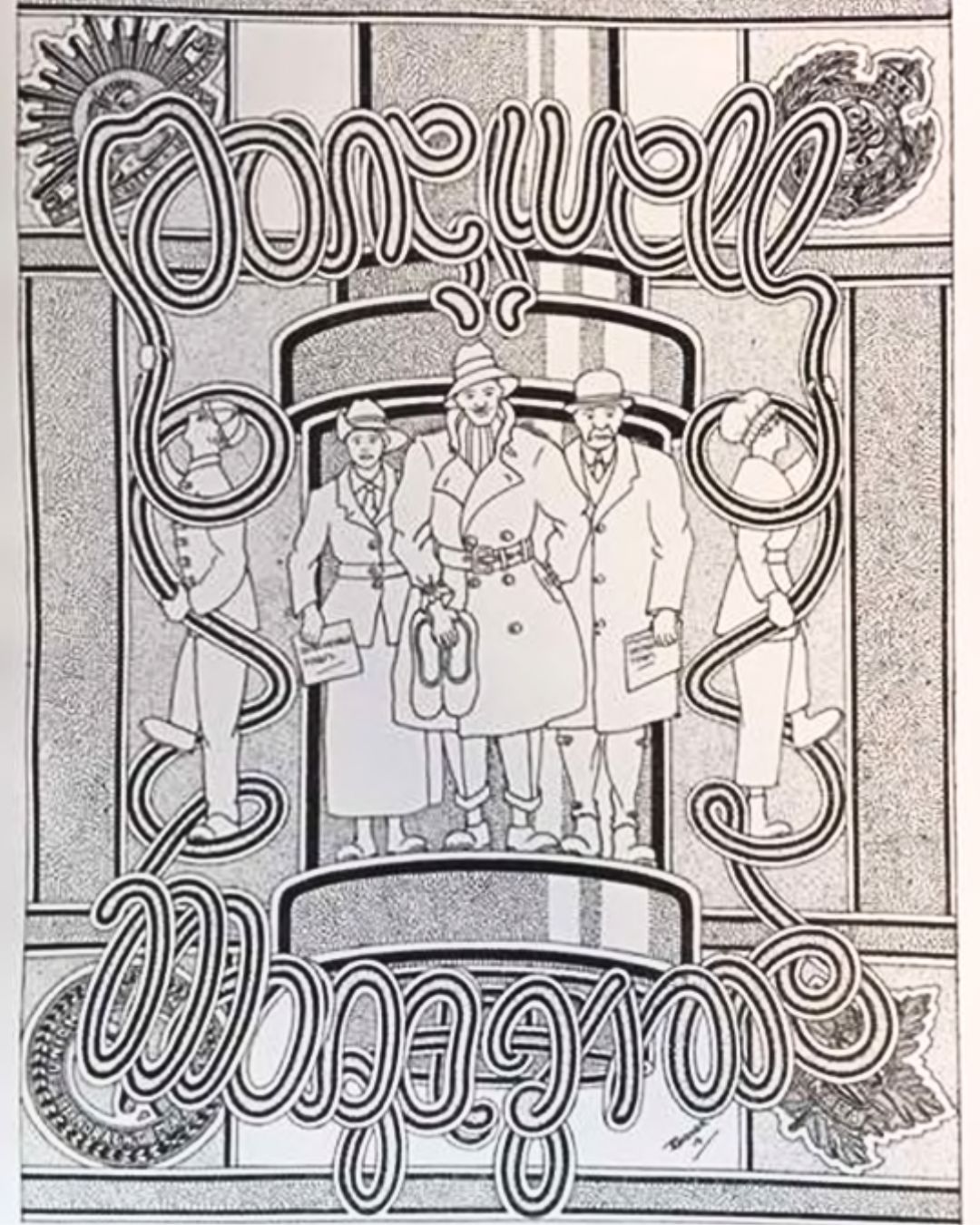
- This magazine was compiled by workers in the Mossband section of H.M. Factory Gretna to remember their time working at the factory.
- The rural site of the factory stretched from Dornock in Scotland to Longtown in England, with the Mossband section being located near Longtown.
- Two vital townships were also built to accommodate and facilitate the munitions workers who came to work there. These were Eastriggs and Gretna, with the latter being where the central officers were located. Perhaps this could be one reason why the government at the time chose to name the site H.M. Factory Gretna (another could include not wishing to give away the exact location of the munitions factory.)
The Mossband Farewell Magazine.
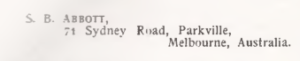
- We don’t know Sydney’s address for while he worked at the factory (maybe, he could have been familiar with Sydney Road in Eastriggs, which is named after the Australian original), but he does leave a forwarding address in The Mossband Farewell Magazine. [1]
- Under “Cordite Staff, Mossband 1916 to 1918” is an “S. B. Abbott,” who we have reason to believe is Sydney, and his address is given as 71 Sydney Road, Parkville, Melbourne, Australia.
- He’s not the only chemist who came to work at H.M. Factory Gretna. Some memorable examples include future inventor of Vegemite, Cyril Callister, [2] and Arthur Parkin, who named his daughter after Gretna township [3].
- Perhaps, this is due at least in some part, to Arthur Leighton Edgar, who, organised a scheme for Australian chemists and engineers to travel to Britain and work with munitions. The intention was to help provide a workforce and help Australians to learn new skills. [4]
- It’s possible that Sydney came as part of this scheme.
Return to Australia
- Further evidence of Sydney’s time at the factory can be found in his records on leaving it.
- He is recorded as a chemist, when he boards the SS Devanha ship in Devonport in May 1919.
- At this point, he is 26 and Sydney is given as where he is from (we doubt this is a reference to the Road in Eastriggs though!).
- After his time at the factory, it appears Sydney went to Melbourne University.
- It’s possible that his studies were interrupted during World War One and he returned to them afterwards.
- As it was, Sydney appears in a list of Melbourne University graduates and undergraduates published in a university magazine in July 1920.
- Considering he only boarded the SS Devanha in May 1919, this is just over a year.
Later Life
- We know Sydney and Isabel had three children, born after Sydney’s return to Australia.
- In 1921, their eldest, Sydney Charles Bertram Abbot, was born.
- During World War Two, Sydney Charles sadly died in an air crash in Norfolk. [5]
- On his roll of honor, his father’s occupation is given as “assistant manager, explosives factory, Maribyrnong, Vic.” [5]
- This is interesting it seems to suggest that Leighton’s scheme met with some success, at least in this instance.
- Seemingly, the Maribyrnong site was used in both World War One and World War Two. [9]
- We don’t know exactly when Sydney started working at the site, but perhaps it could have been after he finished at university. What do you think? So far we’ve found no further evidence to give us more details.
- We DO know that Sydney appears to have worked there during World War Two.
- His son, Sydney Charles, also seems to have worked their prior for being called up and serving with R.A.A.F. [5]
- During World War Two, there was an increase in demand for Australian munitions.
- The already established Maribyrnong site seemed to play a vital role here, as the staff were already trained and therefore, could help to upskill others at least initially. [6]
- However, they also produced munitions and worked on new processes to create them.
- One interesting example, given that H.M. Factory Gretna worked on the production of cordite in World War One, was that the Maribyrnong Explosive Factory developed a new process of making cordite. [6] Could Sydney have been involved in this given his prior cordite-related experience? What do you think?
- It also seems as though some part of the Australian factory was involved in the manufacture of cordite during World War One. [9]
- Sadly, in 1943, the same year as their eldest sons death, their second eldest son, David Abbot also died. [5]
- David was 16 years old when the ship he was on was torpedoed. [5]
- This must have been an unimaginably hard time for their remaining family.
- What we do know is that Sydney and Isabel returned to visit England in 1950.
- On this occasion Sydney’s occupation is given as a civil servant.
- Later, Sydney returned to Australia.
- On the 3rd May 1976 he died in Victoria, Australia.
- As for the Maribyrong Explosive Factory, this specific site closed in the late 20th to early 21st century (we’ve found a couple different dates online ranging from 1994[6] or 2000 [8] to 2005 [7], while the biography of Les McLean states 1989 [9]).
- The site has been historically listed, but has been left dormant. Perhaps in part due to the asbestos in some parts of the Maribyrong Explosive Factory building. [6] [7] [8]
- In more recent years there appear to have been some fires at the site. [7] [8]
Sources and Further Information
- Cordite Staff, Mossband 1916 to 1918, page 13, The Mossband Farewell Magazine from H.M. Factory Gretna.
- Worker of the Week: Cyril Callister – https://www.devilsporridge.org.uk/cyrilcallister
- Worker of the Week: Arthur Parkin – https://www.devilsporridge.org.uk/worker-of-the-week-arthur-parkin
- Anticipating Tomorrow’s Defence Needs – A century of Australian Defence Science by Peter Donovan published 2007 by The defence Science and Technology Organisation, Canberra, Australia.
- Virtual War Memorial for Sydeny Charles Betrum Abbot – https://vwma.org.au/explore/people/617648
- Defence Explosive Factory Maribyrnong Wikipedia – https://en.wikipedia.org/wiki/Defence_Explosive_Factory_Maribyrnong
- Defence Site Maribyrnong, Australian Government Defence Website – https://www.defence.gov.au/about/locations-property/delivering-future-estate/defence-site-maribyrnong
- Defence Site Maribyrong, GML Heritage – https://gml.com.au/projects/defence-site-maribyrnong/
- History of the Munitions Factories by Les McLean (was a manager at the Maribyrong Ordinance Factory in 1945. Could Sydney have worked with him?), Living Museum – https://livingmuseum.org.au/history-of-the-munitions-factories-by-les-mclean/
Find Sydney Bertram Abbot’s online database entry by clicking here>
Do you have a relative who worked at H.M. Factory Gretna? We would love to hear from you! Please feel free to contact us by emailing info@devilsporridge.org.uk. You never know maybe your relative could feature in a future Worker of the Week blog post! You can also have a look at some more H.M. Factory Gretna workers on our online database here>