

Worker of the Week is a series of blog posts which highlights the workers at H.M. Factory Gretna that our volunteers researched for The Miracle Workers Project. This project aimed to centralise all of the 30,000 people who worked at Gretna during World War One and, although it may be over, our amazing research volunteers are continuing to uncover more stories about H.M. Factory Gretna workers to be added to this database. We are always looking to learn more about H.M. Factory Gretna workers. If you know anything about a H.M. Factory Gretna worker please feel free to get in touch with us by contacting info@devilsporridge.org.uk A huge thank you to all our amazing research volunteers for continuing to make this possible.
This week’s Worker of the Week is Maria Armstrong, who once had too much to drink during her time working at H.M. Factory Gretna.
Early Life
- Firstly, on 23rd April 1879 Maria was born in Carlisle.
- Her parents were Christopher and Isabella Armstrong.
- Maria was one of eight children, although only six survived.
- According to census records the family lived in Botchergate, Carlisle in 1881 and Maria’s father, Christopher, worked as a printer compositor.
- Following this, the family had moved to Hexham by 1891. At this point Christopher worked as a printer and stationer.
- Census records show us that the family continued to live in Hexham.
- However, by the 1911 census Isabella is described as a widow.
- Meanwhile, Maria is working as a Stationer, similarly to her father in years gone past.
Time at H.M. Factory Gretna
- After this, that we have found a record of a Maria Armstrong working as a munition worker at H.M. Factory Gretna.*
- Is this the same Maria? What do you think?
- Although we don’t know exactly when this Maria started at the factory we do know that she was working there in January 1917.
- This is because she appears in the local newspaper in court at Dumfries, after having too much to drink.
- Seemingly:
“Maria Armstrong, a munition worker, pleaded guilty to committing breach of the peace.”
– The Dumfries and Galloway Standard newspaper, Wednesday 17th January 1917. [1]
- Now, it is important to note that we don’t have too much information about Maria Armstrong and it’s hard to know the full context of what led to this situation.
- According to the newspaper it took place in one of the factory hostels, which seemingly Maria would have been staying at during this time.
-
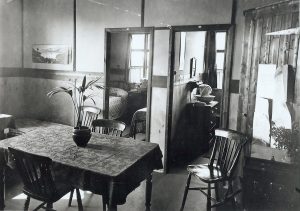
- Inside a hostel.
-

- Inside a hostel.
- However, according to the report in the Dumfries and Galloway Standard, Maria Armstrong…
“was the worse of drink and used very threatening language towards the matron.”
– The Dumfries and Galloway Standard newspaper.[1]
- From what the newspaper report suggests this “threatening language” appears to have been violent threats concerning murdering the matron.
- Naturally, this behaviour wasn’t something that wouldn’t go unpunished.
- Ultimately, Maria Armstrong was given a £3 fine or “the alternative of fourteen days’ imprisonment.” [1]
- According to the bank of England inflation calculator, this would be equivalent to aproximatly £182.32 as of February 2026. [5]

Messroom inside a Hostel.
- Hostel matrons were supposed to look after those who lived in the hostel.
- One example of a hostel matron that we know more about is Christina Muddie Thom. [2]
- Significantly, we have no evidence to suggest that Christina was the matron who was threatened in this instance though.

We don’t know which hostel this happened in. Many of the hostels were named after well-know people, like the one shown above.
- Additionally this case led…
“The Sheriff said they must put a stop to this disgraceful conduct.”
– The Dumfries and Galloway Standard. [1]
Another ‘Threatening’ Incident at the Factory
- Indeed, this was not the first threatening incident that a happened at the factory.
- Notably, James Cecil Wallace Auld [4] and Robert Wotherspoon [3] were threatened with a knife in a local cemetery after this in May 1917.
- However, neither Maria Armstorng or any hostel matrons appear to have been involved in this incident.
Life After the Factory
- In 1939, we have found a census record showing a Maria Armstrong went to live with her sister in Hexham.
- By this point she is described as a retired stationer.
- Unfortunately, we don’t know much more about Maria Armstrong.
- Do you know more about Maria or anyone else who worked at H.M. Factory Gretna? We would love to hear from you! Find out how to get in touch at the end of this blog.
Sources and Further Reading
- “Woman Munition Worker Fined,” Wednesday 17th January 1917, The Dumfries and Galloway Standard newspaper.
- Worker of the Week: Christina Muddie Thom – www.devilsporridge.org.uk/worker-of-the-week-christina-muddie-thom
- Worker of the Week: Robert Wotherspoon – www.devilsporridge.org.uk/worker-of-the-week-robert-wotherspoon
- Worker of the Week: James Auld – www.devilsporridge.org.uk/worker-of-the-week-james-auld
- The Bank of England Inflation Calculator – www.bankofengland.co.uk/monetary-policy/inflation/inflation-calculator
Find Maria Armstrong’s online database entry by clicking here>
*Although, the factory was named H.M. Factory Gretna by the government at the time, it is important to note that the rural site actually went from Dornock in Scotland to Longtown in England. It’s namesake, Gretna (not to confused with separate Gretna Green, which already existed prior to this) and Eastriggs were the two townships built to house and facilitate the influx of people who came to work at the munitions factory during World War One. Both these townships played a vital role to the factory and would have been an integral part in the lives of many of those who worked there.
Do you have a relative who worked at H.M. Factory Gretna? We would love to hear from you! Please feel free to contact us by emailing info@devilsporridge.org.uk. You never know maybe your relative could feature in a future Worker of the Week blog post! You can also have a look at some more H.M. Factory Gretna workers on our online database here>