

Worker of the Week is a series of blog posts which highlights the workers at H.M. Factory Gretna that our volunteers researched for The Miracle Workers Project. This project aimed to centralise all of the 30,000 people who worked at Gretna during World War One and, although it may be over, our amazing research volunteers are continuing to uncover more stories about H.M. Factory Gretna workers to be added to this database. We are always looking to learn more about H.M. Factory Gretna workers. If you know anything about a H.M. Factory Gretna worker please feel free to get in touch with us by contacting info@devilsporridge.org.uk Thanks to our research volunteers, past and present, for their help with this!
This week’s Worker of the Week is Norman Taylor Fox who worked as a chemist at H.M. Factory Gretna and lived in Eastriggs. Find out more about him below.
Early Life
- Firstly, on 23rd October 1888, Norman was born in Longsight, Lancashire.
- His parents were Charles Edward Fox and Mary Jane Bowker.
- Initially, Charles worked as a Cotton Linen Dryer.
- However, he later went on to travel for a Chemical Works.
- Accordingly, we know the family must have moved to Lisburn, Ireland.
- This is because, Norman’s younger brother, Edward Bowker Fox, was born there in 1893.
- Sadly, Edward died when he was 7 years old in 1901.
- At this point the family was living in Dunmurry, Ireland.
- After this, the 1911 census the family returned to Lancashire.
Time at H.M. Factory Gretna

- According to the local electoral role, ‘Norman T. Fox’ worked as a chemist at the factory.
- Additionally, he lived at 100 – 102 Vancouver Road in Eastriggs.
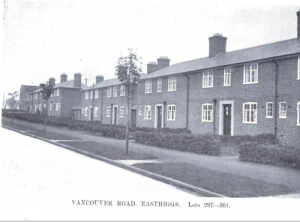
Vancouver Road as shown in an Auction Book from 1924 (when the Factory and townships were sold).
- Eastriggs was one of the two townships (the other being Gretna) built to house and facilitate all those who came to work at the factory.
- Notably, the rural site of the factory actual stretched from Dornock to Longtown (with the two main sections being Doronock and Mossband, near Longtown), but these two townships were vital to the factory and those who worked there.
- The Factory Manual describes Eastriggs as being built “for the accommodation of those workers chiefly engaged on the Dornock section.” [4]
- Significantly, this is not the only reference we have found to Norman working in this section of the factory.
The Dornock Farewell Magazine
- The Dornock Farwell Magazine was created by people who worked at the H.M. Factory Gretna to remember and commemorate their time working at the factory at the end of the war.
- Similarly, The Mossband Farewell magazine was created by those who worked at the other section.

Front page of The Dornock Farewell Magazine.
- A forwarding address for an N. T. Fox appears among the staff addresses in The Dornock Farewell Magazine.
- This is given as ” “Lyndale.” Greenleach Lane, Worsley, Manchester.” [1]
- However, we think it’s possible that this is not the only occasion that Norman appears in this Magazine.

The 11.20 “Up Express”
- We think he could have written an article for it titled “The 11.20 “Up Express.” [2]
- Significantly, only the initials of the author (“N. T .F”) are given, but it does seem to be written from the perspective of the chemist.
- Do you think that N. T. F could be Norman?
- The article itself records a local train journey “on a dark, unhealthy September night” with the
“Chemists recline[ing] in luxuriously-upholstered carriages, critising the latest war position, whereas all others aboard sit on hard, cold, rigid seats. These latter compartments, it is expected, will be sold under the hammer of the Minister of Munitions for hen-roots or ice cream vans, if the Minister can find a speculative party of buyers.”
– The Dornock Farewell Magazine. [2]
- However, this train journey is interrupted when it reached:
“The line at this point bridges a gully, and this becomes the scene of a terrible smash… The first coach has left the rails, with one end in the bottom of the gully and the other resting against the bridge, the following two are over on their sides, and the fourth has jumped the metals.”
-The Dornock Farewell Magazine. [2]
- The article continues to describe the “confusion” after this and describes “the scene as a whole would have insured good running for a Cinema film.”
- Fortunately “four Dornock Chemists proceed to give assistance” who:
“become heroes – and are told a hundred and one in confidences.”
- Ultimately, the chemists retire to their wooden huts.
- After this, what is described as an “extract from the press at the time” is quoted.
- This reads:
“The Minister of Munitions makes the following announcement:—
“ A statement has appeared in the Press that, as a result of a Railway Accident
at a Scottish Munition Factory, several lives were lost.
The accident in question was of a minor character. No lives were lost, but nine
persons sustained cuts and contusions.”– The Dornock Farewell Magazine.[2]
- The contradictory nature of this “extract from the press at the time” has lead us to wonder if it could be satirical comment on the way The Ministry of Munitions reported on at the time.
- Often they would want to downplay the impact of any accident.
- For example, when Roberta Robertson was sadly killed as a result of an explosion and nine others were injured, The Ministry of Munitions made a point of empathising “no serious damage was done.”[3]
- So far we have come across no further accounts of this incident on the way to “Rigg Power House.”
- Additionally, with those “four Dornock chemists” becoming “heroes” rescuing “trembling damsels” with “beautiful silvery voices” and “diamond tiaras” it does perhaps seem more like a “Cinema” story than a factual account…
- What do you think?
- Notably, the Quintinshill Rail accident happened locally only around three years prior on 22nd May 1915.
- Would N. T. F. have been aware of this?
Married Life
- After working at the factory we know Norman returned to Lancashire.
- He married Evelyn Gasquoine there in 1918.
- Following this, Norman and Evelyn went on to have three children.
- Meanwhile, Norman became the manager of a chemical works in Lancashire.
- Lastly, in May 1954, Norman died in Lancashire.
- He is buried alongside his wife and daughter in Heaton Cemetary, Bolton Lancashire.
Sources and Further Information
- Page 66, Staff Addresses, The Dornock Farewell Magazine from H.M. Factory Gretna. 1918- 1919.
- Page 42 -43, The 11.20 “Up Express,” The Dornock Farewell Magazine from H.M. Factory Gretna. 1918- 1919.
- Worker of the Week: Roberta Robertson – https://www.devilsporridge.org.uk/worker-of-the-week-roberta-robertson
- The Factory Manual for H.M. Factory Gretna.
Read Norman Taylor Fox’s online database entry here>
Do you have a relative who worked at H.M. Factory Gretna? We would love to hear from you! Please feel free to contact us by emailing info@devilsporridge.org.uk. You never know maybe your relative could feature in a future Worker of the Week blog post! You can also have a look at some more H.M. Factory Gretna workers on our online database here>