

Worker of the Week is a series of blog posts which highlights the workers at H.M. Factory Gretna that our volunteers researched for The Miracle Workers Project. This project aimed to centralise all of the 30,000 people who worked at Gretna during World War One and, although it may be over, our amazing research volunteers are continuing to uncover more stories about H.M. Factory Gretna workers to be added to this database. We are always looking to learn more about H.M. Factory Gretna workers. If you know anything about a H.M. Factory Gretna worker please feel free to get in touch with us by contacting info@devilsporridge.org.uk A huge thank you goes to all our research volunteers, without them these blog posts wouldn’t be possible!
This week’s Worker of the Week, Thomas George Dippie was born in Australia, seems to have been involved in more than one performance during his time working at H.M. Factory Gretna and once had a newspaper-worthy case of indigestion!
Early Life
In 1884 Thomas was born in Collingwood, Victoria, Australia.
His parents were Jessie (Louttit) and George Dippie. Both George and Jessie seem to have travelled separately to South Australia prior to Thomas’ birth. George travelled from London to South Australia in 1878, whilst his mother left Plymouth for Australia in 1881. It seem that they both could have met during their time in Australia and married on 7th July 1882 in Adelaide.
Following Thomas’ birth we know the family moved to Scotland, although there has been no passenger list found recording their return journey. What we have found is that they are recorded as living in Edinburgh in the 1891 census.
By the 1901 census, the family has changed house, but is still living in Edinburgh.
First Marriage
Our next record of Thomas happens to be from his first marriage.
On the 24th June 1911 Thomas married Mary McLeod. Their marriage took place in Dunbarton.
H.M. Factory Gretna
Although we do not know exactly when Thomas and Mary moved to Gretna, we have found them both in the electoral register for Gretna in 1918 to 1919. They are listed as living in 9 T West in Gretna and Thomas is described as a clerical assistant.

Mary and Thomas appear on the electoral roll for Gretna for 1918 to 1919.
Although the rural factory site actually stretched from Longtown in England to Dornock in Scotland, Gretna was one of the townships (the other of which was Eastriggs) built to accommodate all those who worked at the factory. As described in the H.M. Factory Gretna manual Gretna township was also the site for “Central Administration Offices for the whole Factory”[1]. Accordingly, perhaps Thomas could have worked in these central offices as a clerical assistant. We do not know of Mary’s occupation, but is not impossible that she could have possibly worked at H.M. Factory Gretna.
Indeed, we have found evidence that suggests Thomas and Mary were highly likely to have lived in the area from at least 1917 (some time before the demobilisation of H.M. Factory Gretna began on 6th December 1918).
Turns out Thomas was a performer and appeared in many productions, especially during 1917! These performances include:
- A concert in aid of Gretna School & Athletic Association Benevolent Fund in 1917;
- Appears to have helped arrange two concerts for the ‘Fancy Fair’ also in 1917;
- Took part in an open air concert at a carnival for France’s Day on 25th August 1917 and patriated in a mounted wrestling competition at this event too.
The Gretna Choral and Operatic Society
With Thomas’ clear enthusiasm for performing, it is unsurprising that we think that he could have also been a member ‘The Gretna Choral and Operatic Society.’ [2] We know the society held at least four performances at The Border Hall in Gretna and we’ve previously covered one of the founding members of this society Alexander McKenzie Lupton in our Worker of the Week blog [3].
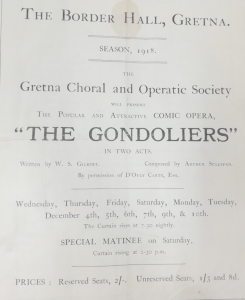
The front of The Gondoliers programme.
The last performance from The Gretna Choral and Operatic Society was The Gondoliers at The Border Hall in Gretna, and we have found a certain Mr T. G. Dippie in the cast list. Was this Thomas? We think so.
He is listed as playing Giuseppe Palmieri, one of the Venetian gondoliers in play, which is apparently a role for a baritone [6]. Thomas would have preformed alongside Alexander Lupton [3] as previously mentioned and Egerton Sayer who we have also covered in a prior Worker of the Week blog [4].
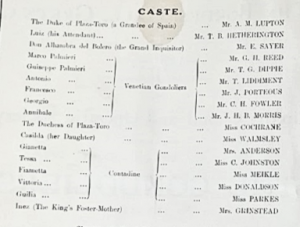
Can you see any familiar names in this cast list?
If your interested in watching a more modern performance (bearing in mind the performance Thomas was involved in was over 100 years ago) of ‘The Gondoliers’ we have come across a version of this on BBC iPlayer. At the time of writing you can find the The Gondoliers on BBC iPlayer by clicking here>

Inside The Border Hall in Gretna where Alexander and Thomas would have preformed with The Gretna Choral and Operatic Society.
This performance at The Border Hall in Gretna, as well as the other events Thomas was involved in, were part of a range of recreational facilities and activities that were available for H.M. Factory Gretna workers to get involved with. In fact, there was a Social and Recreational Department at H.M. Factory Gretna which was in charge of this.
Not only does this show that they were aware of the happiness of those who worked at the factory could have a positive impact on their productivity and keep them out of mischief, but it also highlights the duty of care they felt in looking after the munitions workers, many of which were young women around 16 or 17 years old. For many of these working at the factory would have been their first time living away from home. However, there was still a Women’s Police Force to keep them on track. A strict 9pm curfew was imposed on munitions workers hostels by the Women’s Police Force and they used to check the back rows of cinemas!
Back to Thomas and we unfortunately do not know if he was involved in any of the other performances given by The Gretna and Choral Operatic Society. Given that he appears to be a keen performer, it would be lovely to think he was!
(If only our museum team was equally as enthusiastic as performing for The Devil’s Porridge Museum’s TikTok… but that does leave us to wonder what Thomas George Dippie, himself would have thought about TikTok? Or perhaps, our museum assistant should not be trying to write a blog and plan a TikTok at the same time…)
Indigestion?
Anyway, it appears that Thomas stayed living in Gretna until at least sometime around 1920. How do we know this? Well, because Thomas had ingestion.
More specifically, he seems to have appeared in a numerous newspapers in an advert published in 1920 as “Mr. T. G. Dippie” from “9 West, Gretna” for Bisurated Magnesia. According to the aforementioned advert, “it is generally recognised that for all ordinary cases of stomach trouble, including Indigestion, Flatulence, Heartburn, Gastritis etc., Bisurated Magnesia is an unrivalled remedy.”[5] This advert continues to give the testimony of Thomas which follows:
“For over 15 years I suffered a form of indigestion which produced acute pain… I consulted several doctors and attended a Royal Infirmary, but only got temporary relief. About four months ago I decided to try Bisurated Magnesia; after the second dose I had not another pain.”
– Mr. T. G. Dippie from 9 West, Gretna as recorded in an advert for Bisurated Magnesia. [5]
In the words of the research volunteer who kindly found this information about Thomas, we ‘hope he was rewarded for this endorsement!’
Second Marriage
Sadly, our next record is Mary’s death in 1945. Presumably, this was early in the year.
It appears that by mid-September Thomas married again, this time to Georgina Catherine Margaret Coventry in Edinburgh. Georgina was a music teacher. However, it appears that this second marriage perhaps wasn’t to be. After around six years it appears that Thomas and Georgina divorced on 3rd May 1951.
Later Life
From what we know we can assume that Thomas spent the majority of the rest of his life in Scotland.
In 1955, at the age of 70 years old George died in hospital in Glasgow.
Sources and Further Reading
[1] H.M. Factory Gretna Manual from The Devil’s Porridge Museum’s archives. [2] Gretna Choral and Operatic Society, The Gondoliers programme, December 1918 from The Devil’s Porridge Museum’s archive. [5] The British Newspaper Archive.[6] The Gondoliers Wikipedia – https://en.wikipedia.org/wiki/The_Gondoliers
Find Thomas George Dippie’s online database entry by clicking here>
Do you have a relative who worked at H.M. Factory Gretna? We would love to hear from you! Please feel free to contact us by emailing info@devilsporridge.org.uk. You never know maybe your relative feature in a future Worker of the Week blog post! You can also have a look at some more H.M. Factory Gretna workers on our online database here>
Join our Project: Exploring the Commonwealth, Migration & Home
We find it important to remember and the contribution of people who came to work at H.M. Factory Gretna from the Commonwealth and beyond. Although many of the stories we share focus on are from the past, like that of Thomas George Dippie who was born in Australia, Australian Clifford Arthur Abbot or Cyril Callister and Canadian brothers Robert Dalton & Knox Affleck, we know that the varied experience of migration and home across different communities is equally important today. We hope to foster empathy and raise awareness of this by sharing diverse personal narratives through our Exploring the Commonwealth, Migration and Home project.
Currently, The Devil’s Porridge Museum is researching the historical and contemporary factors that drive migration within the Commonwealth nations, exploring personal narratives of migration, and examining the meaning of home through our Commonwealth, Migration and Home project. Our project seeks to foster empathy and awareness of the varied experiences of migration and home across different communities. We are looking for people who have migrated Commonwealth country or have Commonwealth heritage to help us with this project and we would love to hear your story.
By sharing your experiences, you will help create a deeper understanding of migration, identity and home, while contributing to a project that highlights diverse voices and histories. If you would be interested in getting involved in our Commonwealth, Migration and Home Project you can read more by clicking here>