
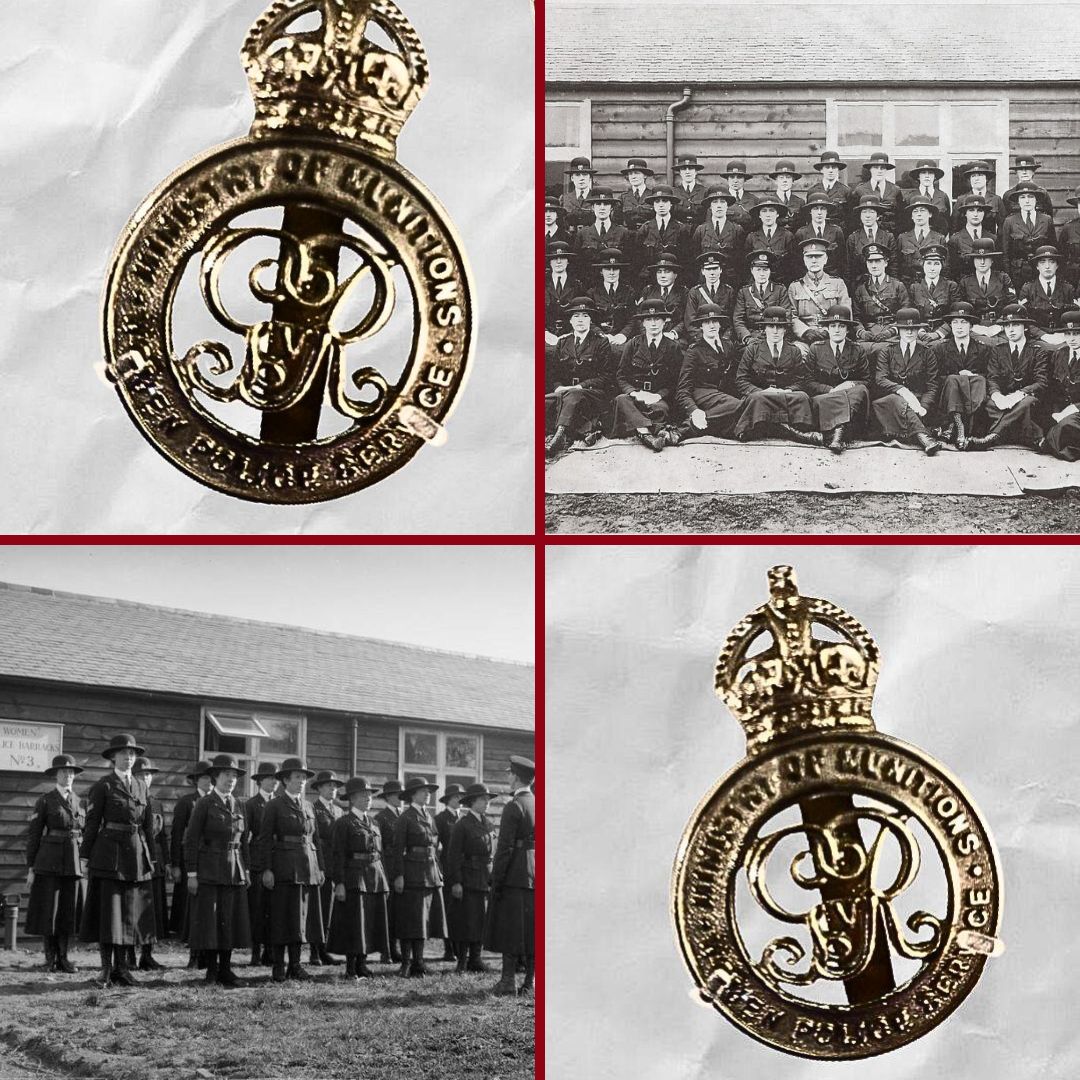
Worker of the Week is a series of blog posts which highlights the workers at H.M. Factory Gretna that our volunteers researched for The Miracle Workers Project. This project aimed to centralise all of the 30,000 people who worked at the factory during World War One and, although it may be over, our amazing research volunteers are continuing to uncover more stories about H.M. Factory Gretna workers to be added to this database. We are always looking to learn more about H.M. Factory Gretna workers. If you know anything about a H.M. Factory Gretna worker please feel free to get in touch with us by contacting info@devilsporridge.org.uk
Did you know that in June 1918, H.M. Factory Gretna’s women’s police force reached it’s peak with 167 members? We’re honouring this with this week’s Worker of the Week with the story of one of the factories women’s police officers, Marjorie Beryl Pearse. This information has been supplied through part of a research project led by Nigel Crompton. A huge thank you to everyone involved in this.
Early Life
Marjorie was born on the 3rd August 1988 in Flitwick, Bedfordshire. She had four older siblings and one younger sibling. Her parents were Alfred and Mary Pearse.
Her father, Alfred was a well-known illustration for many newspapers and publications. Some of the publications he worked on include the Illustrated London News, The Sphere and Punch, but Alfred is likely to be best well known for spending 45 years as a illustrator on the Boy’s Own Paper. Some of Alfred’s drawings also appeared in the Girls Own paper.
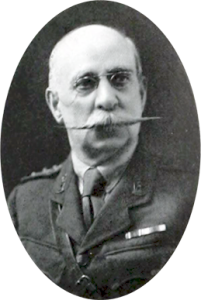
Alfred Pearse. Photo Source: By Elliott & Fry (photographic studio)(Life time: 1863–1963) – Original publication: Notable Londoners: An Illustrated Who’s Who of Professional and Business Men. London: London Publishing Agency. p. 183Immediate source: https://archive.org/details/notablelondoners00lond/page/182/mode/2up, Public Domain, https://commons.wikimedia.org/w/index.php?curid=154222373
By the 1901 census, we are aware that the family has moved to live in Hampstead in North London. An interesting connection is that Alfred appears to have created four illustrations for an essay about The Boer War in The World Wide Magazine, which was written by Arthur Conan Doyle. [1] This is the same Sir Arthur Conan Doyle who later visited H.M. Factory Gretna and coined the phrase ‘devil’s porridge.’
The next record we find of the family also regards Marjorie’s father. Alfred put his talents as an accomplished artist to good use for the women’s suffrage campaign. Indeed, Alfred was a founding member of the ‘Suffrage Atelier’ – an artists collective campaigning for women’s suffrage – during February 1909. He created several hard hitting posters, especially regarding the force feeding of suffragettes in Holloway Prison. It seems that Alfred sometimes used the pseudonym ‘A. Patriot’, as in the Votes for Women poster in the Victoria and Albert Museum’s collection. [2]
It seems that Alfred was a keen campaigner. Perhaps his support of the women’s suffrage movement was even influenced by Marjory and his other daughters.
The 1911 census shows us that Marjorie and her younger sister are still living in Hampstead with their parents. While Alfred’s occupation is described as an artist, 22 year old Marjorie was working as a sectary. However, we have found no record of who she was working for.
Traveling
In 1913, Marjorie and her older sister Dulcie visited Canada. The sisters sailed aboard the SS Grampion, which was later used to transport troops from Canada – often taking them to Liverpool – during World War One.
It seems as though both sisters stayed in Canada for a few years. Both Marjorie and Dulcie returned during September 1916 on the same ship they left aboard, the SS Grampion.
Dulcie seems to have enjoyed her time in Canada so much that she returned the following month! Indeed, it seems she stayed there for the rest of her life, as we know Duclie died in Canada in 1968.
Life at H.M. Factory Gretna
Following Marjorie’s visit to Canada and after the start of the First World War, we next find her in Gretna. Her name appears on the 1917 to 1918 valuation roll for Gretna. It seems as though she was serving in the Women’s Police Force (WPS).
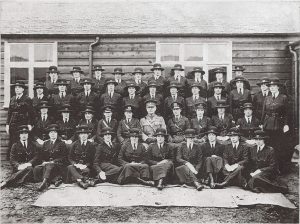
Some of H.M. Factory Gretna’s Women’s Police Force. Could Marjorie perhaps possibly appear in this photo?
As a member of the Women’s Police Force at H.M. Factory Gretna Marjorie could have done a variety of jobs to ensure the smooth running of the factory, while caring for the welfare and safety of those who worked there.
Members of the Women’s Police Force would search munitions workers entering the factory to make sure that they did not bring any contraband in, for example. Contraband included metal items or matches with could potentially cause sparks and an explosion. If munitions workers were found to be carrying any of these items, they would be confiscated (we are aware of some records suggesting that metal buttons were even cut off clothing) and the munition worker responsible would be fined.
They also search munitions workers on the way out for “any factory property which they had become too attached.” [6]
Not only that but the Women’s Police Force also helped to enforce a 10pm curfew on hostels at the factory and were known to have stopped a couple kissing on the railway platform. They also used to inspect the back rows of the cinemas. [4]
Some of these actions may seem extreme to us now, but the Ministry of Munitions felt that they had a duty of care for the young munitions workers. A large proportion of the workforce at H.M. Factory Gretna was aged under 18. Many of these could be around sixteen or seventeen years old, although we have found evidence that some may have been even younger. Take Agnes Ross McNaught, for example. She would have been around fourteen or fifteen years old while she was working at H.M. Factory Gretna. [5]
The welfare of H.M. Factory Gretna workers was so important that there was even a Social and Recreational Department set up to oversee all recreational facilities and activities. This ranged from women’s football, to tennis courts and cinemas for the H.M. Factory Gretna workers. There was certainly plenty to keep the factory workers occupied outside their working hours. The Women’s Police Force had a vital roll in looking after them and making sure they kept out of mischief in their free time too!

We also know that Marjorie lived in Women’s Police Barracks No. 1 during her time working in the WPS.
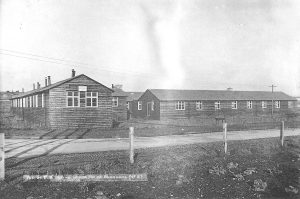
Gretna Women’s Police Barracks, Number 2.
Marjorie was not the only one doing her bit for the war effort. Meanwhile, in 1918, her father Alfred became an official war artist. He was given the rank of Honorary Captain in the New Zealand Rifle Brigade.
Marriage
However, we know that Marjorie’s career in policing did not last. According, to the 1921 census, she was working as a “Lady’s Help.” She had moved back to her home in Hampstead.
Shortly after this, we know she married William Silas Pearce and moved to Norwood in South London.
Marjorie and William had one son born in 1924.
Later Life
Census records indicate that the family seem to have moved around a lot in South London.
Marjorie died in late 1978.
Sources and Further Reading
[3] Alfred Pearse’s Wikipedia Entry – https://en.wikipedia.org/wiki/Alfred_Pearse
[5] Worker of the Week: Agnes Ross McNaught – https://www.devilsporridge.org.uk/agnesrossmcnaught
Find Marjorie Beryl Pearse’s online database entry by clicking here>
Do you have a relative who worked at H.M. Factory Gretna? We would love to hear from you! Please feel free to contact us by emailing info@devilsporridge.org.uk. You never know maybe your relative feature in a future Worker of the Week blog post! You can also have a look at some more H.M. Factory Gretna workers on our online database here>