
Worker of the Week is a series of blog posts which highlights the workers at H.M. Factory Gretna that our volunteers researched for The Miracle Workers Project. This project aimed to centralise all of the 30,000 people who worked at Gretna during World War One and, although it may be over, our amazing research volunteers are continuing to uncover more stories about H.M. Factory Gretna workers to be added to this database. We are always looking to learn more about H.M. Factory Gretna workers. If you know anything about a H.M. Factory Gretna worker please feel free to get in touch with us by contacting info@devilsporridge.org.uk
Mary Hermione Feildon, a member of the Women’s Police Force who had a natural flair for the theatre! A huge thank you to our all research volunteers, with a particular note of thanks to Research Project led by Nigel Crompton for helping to make this possible too!
Mary’s Early Life
On 6th April 1886, Mary Hermione Feildon (it seems as though she may have gone by her middle name Hermione, at least while she worked at H.M. Factory Gretna) we have found was born in Mugginton, Derbyshire. Her parents were Randle and Gertude Emi Feildon.
Randle her father, worked as a Rector in there local church, All Saints Church in Mugginton. It seems possible that Mary could have been baptised at this same church. Either way what we do know is the family were living at The Rectory in Mugginton.
Clearly the family stayed at this address for some time, as the 1891 census still records them at this address.
Following this it becomes tricky to track down Hermione until, well, perhaps you’ll never be able to guess where…
H.M. Factory Gretna
We next find Hermione working at H.M. Factory Gretna!
To be more specific Mary worked as a Women’s Police Officer… and technically, the nine-mile factory site stretched from Dornock in Scotland to Longtown in England, rather than in Gretna like that name given to it at the time suggests. Of course Gretna and Eastriggs were both vital to the factory. Both these townships were built to house and provide all the resources the influx of workers who came to the area would need, especially as there had only really been farm land there prior to the construction of the factory. There were also administration buildings in Gretna and more relevantly to this blog post perhaps, the Women’s Police Barrack’s were in Gretna.

Some members of the Women’s Police Force stood in front of their barracks in Gretna.
This indeed is where we found Hermione! She is living at No. 1 Police Barracks in Gretna along with many of her colleges in the Women’s Police Force, according to the validation role we have for 1917 to 1918. As a member of the Women’s Police Force, Hermione would have helped to ensure the smooth running of the factory and even helped to look after some of the young munitions workers that would have worked there.
Perhaps she would have helped to escort sick munitions workers, mostly suffering from the effects of their dangerous work making cordite, home at the end of their shift. Maybe she would have searched the workers on their way in and out of the factory, or she could have helped with enforcing a strict curfew at the factories hostels and policing the back row of the cinema… All of these activities and more were done by members of the Women’s Police Force or WPS at the factory.
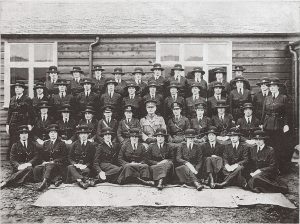
A photo of the women’s police unit at HM Factory Gretna during WW1.
However, this doesn’t seem to be all that Hermione was involved in during her time living in Gretna.
Cheerio Gretna
It seems that Hermione very creative in addition to being theatrical! Not only did she feature in a performance at The Border Hall in Gretna, she also wrote it!
Indeed this is described in the local newspaper as:
“A highly amusing revenue, entitled, “Cheerio Gretna” and written by Constable Hermione Feildon, was produced in the Border Hall on Saturday evening and again on Monday, by the authoress and a band of colleagues in the lady police force of the factory. The play had a strong local flavour… and it is also rich in fun.”
-The Dumfries and Galloway Standard, 12th May 1917, page 5.
In addition Constable Hermione Feildon is listed amongst the cast in further down in the newspaper article; in appears that she played a Duke in this performance!

Exterior of the Border Hall.
It’s lovely to see how Hermione’s work was supported and her revenue realised by her colleagues in The Women’s Police Force. Perhaps, this stands to reason; not only would members of the Women’s Police Force at Gretna worked together, but they would have also lived to together too. There seems to have been a strong sense of community spirt! (We can’t help but wonder if any of the performers did take a wee bit of persuasion though…)
Married Life
Next we find Hermione in Sleaford, 1920, when she met and married John Henry Money, but did this curb her creativity and theatrical flair? No way! Hemione had joined The Heckington Stockers, a local armature dramatics group. Meanwhile, John had a successful band, maybe they would have even preformed the same events together.
In the same year of her marriage we know that Hermione also helped with the entertainment at Bloxholm Hall, Garden Fete on 5th August 1920. She was part of those preforming in the “dramatic entertainment” part of this event according to a newspaper advert, which is listed as taking place at “3.30 and 6 o’clock.”[4]
The 1921 census reveals that John worked as a coach builder (it appears as though he may have worked on wagon repairs). He was a widower and had one child from his previous marrage who was 5 years old at the time of the census. Both John and Hermione appeared to be still living in Lincolnshire in the village of Heckington. In fact they didn’t seem to live very far from John’s workplace.
Armature Dramatics
Meanwhile, Hermione’s enthusiasm for armature dramatics continued!
With her local armature dramatic group, here described as The Heckington Strolling Players, Hermione travelled to the another Cranwell, Lincolnshire to help raise funds for the Church Choir and Sunday School summer excursion. Hermione seems to have taken the lead at this activity:
“The Heckington Strolling Players visited Cranwell on Wednesday and gave a highly successful variety entertainment in the schoolroom. The programme was organised by Mrs. Money (Hermione Feildon) and proved very attractive… The one act play “The Hour and The Man” written by Miss Feildon was a great success. The gross takings amounted to about £5. The next proceeds will be given in aid of Cranwell Church Choir and Sunday School summer excursion. Many thanks are due for the Company for generously helping the fund.”
– The Sleaford Gazette Newspaper, Saturday 2nd April 1921 [5]
This is not the only charity performance Hermione took part in with The Heckington Strolling Players. In February 1922, they preformed at “The Temperance Hall” in the area “with the laudable object of devoting the proceeds towards the immediate relief of any case of distress in the district caused through unemployment.” Once again The Heckington Strolling Players are complemented for their performance, including by noting “the company including the children were thoroughly trained.” Additionally, Hermione seems to have taken charge of the group, as the local newspaper describes below.
“The talented local company, trained by Mrs Hermione Money gave a successful concert and variety entertainment at The Temperance Hall on Wednesday, evening… Mrs Money again proved her ability as an organiser and artist.”
– The Sleaford Gazette Newspaper, 18th February 1922.
It seems that Hermione may have even been involved in writing the performance too.
“The drama of the Dickins period by Hermione Fielding proved a regular thriller. The characters are well sustained. The author made a typical Mother Fagan.”
– The Sleaford Gazzette Newspaper, 18th February 1922.
Is it too far of a stretch to think that Hemione Fielding was a typo and should have been Hermione Feildon? We think not, especially as Mother Fagan is listed further down in that very same article as being played by Mrs Money!
The amateur dramatics seemed to stop for a while following this, or at least the reports in the newspapers did. In 1922, Hermione and John had two twin boys! However, this didn’t stop her from her creativity for long!
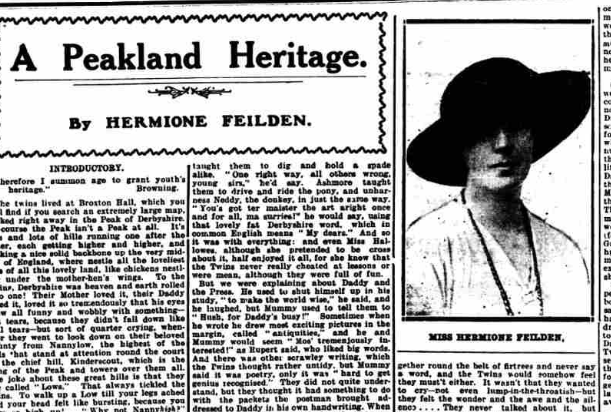
Indeed, it seems that Hermione continued to use her maiden name for her writing. As shown in 1924, when The Derbyshire Advertiser newspaper printed a story written by a certain Hermione Feildon!
The first instalment of Miss Hermine Feildon’s story in The Derbyshire Advertiser, January 1924.
This story was serialised into 24 parts, starting on Saturday 11th January 1924 and running all the way up until 21st June 1924 when the last part was printed! It must have been very exciting for Hermione to have her writing published publicly in a newspaper.
However, the family were hit by tragedy in 1925. One of their twins, Walford died.
The 1930s and Beyond
In the 1930s we know Hermione, John and family moved to Sutton in Surrey. The 1938 Polling District for of Sutton (South East) register lists John and Hemione’s names, so they must have been living in the area by this point at least.
However, we next trace down the family after they have moved to Dorset in 1939, where they lived in the village of Punknowle.
Sadly, John died in the mid 1950s in Chichester.
In May 1977, Hermione passed away in Surrey.

Sources and Further Reading
[3] Armature Theatricals in Gretna from the Dumfries and Galloway Standard newspaper, 12th May 1917, page 5. [4] Bloxham Hall Garden Fete Advertisement from the Sleaford Gazette & South Lincolnshire Advertiser newspaper, Saturday 24th July 1920, page 2. [5] Cranwell article in The Sleaford Gazette newspaper, Saturday 2nd April 1921, page 3. [6] Heckington article in The Sleaford Gazette newspaper, 18th February 1922.
Read Mary Hermione Feildon’s online database entry by clicking here>
Do you have a relative who worked at H.M. Factory Gretna? We would love to hear from you! Please feel free to contact us by emailing info@devilsporridge.org.uk. You never know maybe your relative feature in a future Worker of the Week blog post! You can also have a look at some more H.M. Factory Gretna workers on our online database here>