

Worker of the Week is a series of blog posts which highlights the workers at H.M. Factory Gretna that our volunteers researched for The Miracle Workers Project. This project aimed to centralise all of the 30,000 people who worked at Gretna during World War One and, although it may be over, our amazing research volunteers are continuing to uncover more stories about H.M. Factory Gretna workers to be added to this database. We are always looking to learn more about H.M. Factory Gretna workers. If you know anything about a H.M. Factory Gretna worker please feel free to get in touch with us by contacting info@devilsporridge.org.uk Thank you to all our research volunteers and everyone who has helped with this.
This Worker of the Week blog post is the last that we will be sharing in 2025, so who better to celebrate with than with some members of The Gretna Choral and Operatic Society? Rest assured that our Worker of the Week posts will be returning in 2026, but for now keep reading for a compilation of information about members of The Gretna Choral and Operatic Society.
Introduction
- The Gretna Choral and Operatic Society was one of the many activities or groups factory workers could be involved in.
- They gave performances at The Border Hall in Gretna. [8] [9]
- Their first performance was ‘HMS Pinafore’ in April 1917. [8]
- However, we know they also had productions of ‘Les Cloches de Cornville’ and ‘Paul Jones the Solway Mariner.’ [8]

Exterior of the Border Hall.
- In The Devil’s Porridge Museum’s archive we have a programme for the Gretna Choral and Operatic Society’s last performance.
- This was for the Gondoliers.
- Below we explore the stories of some of the people listed in the programme (and music teacher, Ivy Herbet’s connection to the society).
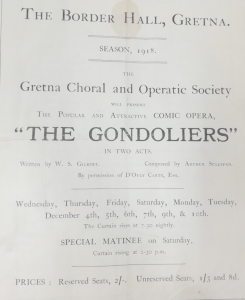
The front of The Gondoliers programme.
Alexander McKenzie Lupton
- Alexander was born in April 1872 at New Luce, Wigtown.
- Apparently, Alexander was one of the founding members of the Gretna Choral and Operatic Society. [8]
- In the Gondoliers programme from 1918 Alexander leads the cast list as “The Duke of Plazo-Toro (a Grandee of Spain)” and was the stage manger too.[9]

Alexander seems to have liked chess.
- Prior to his time at H.M. Factory Gretna, Alexander lived in Stirling.
- According to the The Great War Theatre website, A. M. Lupton (presumably Alexander) was an engineer and well known in the amateur performance community in Stirling. [8]
- He is described as having “full toned baritone voice” in an article in the British Newspaper archive.
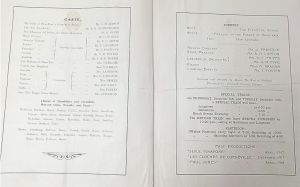
- During his time at H.M. Factory Gretna he worked as a draughtsman.
- After this he continued to preform and went on to lease his own theatre.
- Alexander died in 1946.
James Prentice
- James was born in June 1855 at Dalziel, Lanarkshire, Scotland.
- Significantly, James is the “Musical Director” in the Gondoliers programme from 1918.[9]
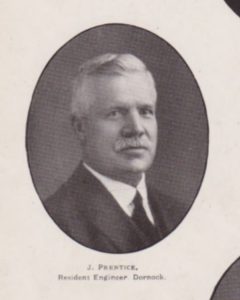
James Prentice’s photo appears in the Dornock Farewell Magazine.
- Before this we know he spent some time living in South Africa.
- During his time at H.M. Factory Gretna, James worked as a resident engineer in the Dornock section of the factory. [11]
- Additionally, James was on the factory Social and Athletic Committee, as the “director of all musical organisations at the committee.”[11]
- The Social and Athletic Committee helped to decide what recreational activities went on at the factory.
- In his role in the Committee James was integral in helping to establish the Factory Band from workers in the Dornock section of H.M. Factory Gretna. [11]
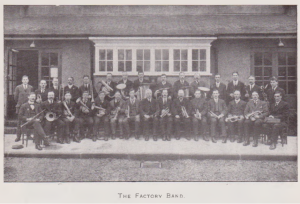
J Prentice sat in the middle of the factory band.
- Following this, James returned to South Africa.
- He died there in August 1931.
Ivy Herbert
- Ivy Herbert was born in June 1893.
- Although, Ivy does not appear on 1918 the Gondoliers programme, it seems highly likely that she was involved helping to train those for the Orchestral Society initially.
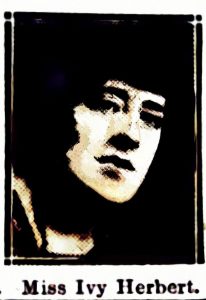
Ivy Herbert picture taken from an article published in the Western Mail in 1928
- This Orchestral Society was established to support the productions of The Choral and Operatic Society.
- Both of these were set up by The Social and Recreational Committee, who were trying to provide factory workers with recreational activities and keep them safely on site as much as possible.
- As part of this Ivy held classes in an upper floor room of the Gretna Institute.
- After her role as a music teacher for the workers at H.M. Factory Gretna came to an end in early spring 1917, a Farewell Concert was held for her in the Border Hall in Gretna.
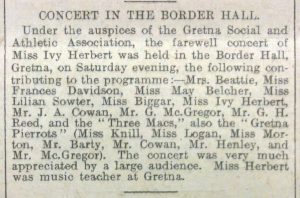
Ivy Herbert Carlisle Journal account of her farewell concert at the Border Hall in March 1917
- Later she continued to teach (initially for the Royal Academy, first as a tutor and then promoted to professor of pianoforte and bestowed the title Associate of the Royal Academy), published music she had composed and appeared in many concerts, including preforming with the National Orchestra of Wales in 1928.
- Continuing with her educational work she had weekly educational radio broadcast for schools which went out on the Cardiff channel.
- Additionally, she featured regularly on radio in concerts and broadcast on the World Service in 1937 performing a series of short recitals which went out on All India Radio.
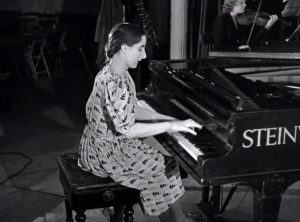
Ivy Herbert taking part in a CEMA organised concert in 1942
- During World War Two she was involved in Council for the Encouragement of Music and Arts (CEMA).
- Her interest in music seems to have continued for all Ivy’s life and if you would like to learn about everything she was involved in (or indeed any of the people mentioned in this post) head to the sources and further reading section of this blog below.
- She died in November 1993, a few months after her 100 year birthday.
Thomas George Dippie
- Firstly, Thomas was born in 1884 in Collingwood, Victoria, Australia.
- In the Gondoliers programme from 1918 Stewart is playing “Giuseppe Palmieri,” who was one of the “Venetian Gondoilers.” [9]

Thomas George Dippe and his wife’s records in the Electoral Role for Gretna in 1918.
- During World War One, we know Thomas worked as a clerical assistant living at Gretna.
- In addition to The Gretna Choral and Operatic Society, we know Thomas took part four concerts locally in 1917.
- These include one in aid of Gretna School & Athletic Association Benevolent Fund and one for France’s Day, were Thomas also patriated in a mounted wrestling competition!
- Later, Thomas appears in a promotional content in a newspaper for something that is advertised as curing indigestion, ‘Bisurated Magnesia.’
- Thomas died in 1955.
Egerton Sayer
- Firstly, Egerton was born in 1864 at Clifton in Bristol.
- Notably, he played “Don Albambra del Bolero (the Grand Inquisitor)” in the 1918 performance of the Gondoliers. [9]
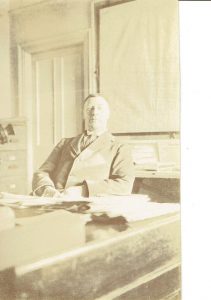
- Initially, James worked as Assistant Chief Electrical Engineer for the Hampstead Electric Lighting committee.
- After this he worked as an electrical engineer in the Mossband (a codename for Longtown) section of H.M. Factory Gretna.
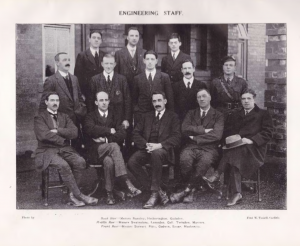
Egerton Sayer can be seen in this photo of the Engineering Staff from the Mossband Farwell Magazine. He is second from the right on the front row.
- Lastly, Egerton died in April 1927 at London.
Stewart Clifford Phipps
- Stewart was born in February 1880 in Birkenhead, Merseyside.
- In the Gondoliers programme from 1918, Stewart is one of the “Leaders of the orchestra.” [9]
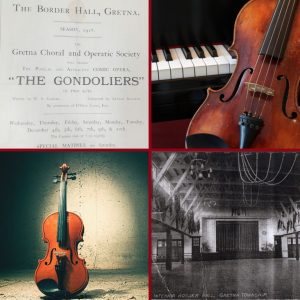
- Before working at H.M. Factory Gretna he was a violinist and then a musical director.
- After this, he worked as a Clerk for the factory.
- Additionally, Stewart was the Leader of the Orchestra and violinist in a performance of Cheerio Gretna in 1917. [10]
- Later, Stewart became a music teacher.
- Stewart died in 1977.
Other Performances at the Factory
- Naturally, The Gretna Choral and Operatic Society weren’t the only ones to preform during their time working at the factory.
- Additionally, The Choral and Operatic Society didn’t only include men.
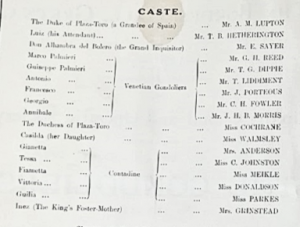
- know Miss Graham played the piano, while Miss Cochrane, Miss Walmsley, Mrs Anderson, Miss C. Johnston, Miss Meikle, Miss Donaldson, Miss Parkes and Mrs Grinstead appear to have played parts in this performance Gondoliers, but unfortunately, we have not managed to track all them down so far. [9]
- The fact that we have the Gondoliers programme in our collection, makes it easier to discover members of The Gretna Choral and Operatic Society, as well as know what their part was in their performance, but unfortunately we haven’t identified everyone in the programme so far.
- Excitingly, earlier this year we were kindly donated a programme for a Concert and Dance put on by The Social and Athletic Association, so there is plenty more for us to dig into soon!
- Importantly, we should also note that the rural site of H.M. Factory Gretna actually stretched Longtown in England to Dornock in Scotland.
- Significantly, the townships of Eastriggs and Gretna were both built for all those who came to work at the factory and were vital.
- As well as providing resources for recreational activities such as dances in The Central Hall in Eastriggs, there were shops, schools, housing and tennis courts; providing a community for all those who worked at the factory with the Women’s Police Force helping to ensure the safety of many young girls on what would have been their first time living away from home.
Social and Recreational Department
- Additionally, The factory had it’s own Social and Recreational Department, which supervised all amusements and recreational activities.
- Not only was it thought that activities could increase productivity, but they would also help to keep munitions workers out of mischief and happy.
- Undeniably, performances at The Border Hall in Gretna was one of the many amusements, which helped them to achieve this.
- One more notable performance at The Border Hall was Cheerio Gretna and you can read about someone who was integral to this production below.
Mary Hermione Feildon
- Firstly, in April 1886, Mary Hermione Feildon was born in Mugginton, Derbyshire.
- It appears that she went by her middle name Hermione.

- Notably, Hermione was a member of the Women’s Police Force at H.M. Factory Gretna.
- However, Hermione also wrote and appeared in a performance of “Cheerio Gretna.” [10]
- This took place in May 1917 at The Border Hall in Gretna.
- Hermione played a Duke and preformed alongside some of her colleges in the Women’s Police Force (including Choral and Operatic Society member, Stewart Clifford Phipps).
- Following this, Hermione moved and became involved in her local armature dramatic group “The Heckington Strolling Players.”
- As well as performing as part of this group, Hermione wrote some of their performances and also appears to have helped train the armature dramatics group.
- Additionally, in 1924, The Derbyshire Advertiser newspaper printed a story written by Hermione, which was serialised in to 11 parts.
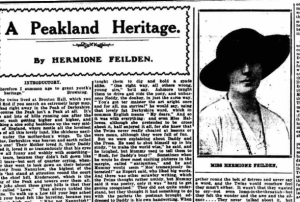
The first instalment of Miss Hermine Feildon’s story in The Derbyshire Advertiser, January 1924.
- She died in May 1977.
Sources and Further Reading
- Alexander McKenzie Lupton – Worker of the Week: Alexander McKenzie Lupton – https://www.devilsporridge.org.uk/worker-of-the-week-alexander-mckenzie-lupton
- James Prentice – Worker of the Week: James Prentice – https://www.devilsporridge.org.uk/worker-of-the-week-james-prentice
- Ivy Herbert – Ivy Herbert – Gretna’s Music Teacher – https://www.devilsporridge.org.uk/ivy-herbert-gretnas-music-teacher
- Thomas Geroge Dippie – Worker of the Week: Thomas George Dippie – https://www.devilsporridge.org.uk/worker-of-the-week-thomas-geroge-dippie
- Egerton Sayer – Worker of the Week: Egerton Sayer – https://www.devilsporridge.org.uk/worker-of-the-week-egerton-sayer
- Stewart Clifford Phipps – Worker of the Week: Stewart Clifford Phipps – https://www.devilsporridge.org.uk/worker-of-the-week-stewart-clifford-phipps
- Mary Hermione Feildon – Worker of the Week: Mary Hermione Feildon – https://www.devilsporridge.org.uk/worker-of-the-week-mary-hermione-feildon
- Cheerio Gretna: Theatre at the Factory by Stuart Gibbs (7th March 2018), The Great War Theatre’s website – https://www.greatwartheatre.org.uk/2018/03/406/
- The Gretna Choral and Operatic Society, The Gondoliers programme, December 1918 from The Devil’s Porridge Museum’s archive.
- Armature Theatricals in Gretna from the Dumfries and Galloway Standard newspaper, 12th May 1917, page 5.
- “Factory Band,” Page 24 – 25, The Dornock Souvenir Magazine.
Do you have a relative who worked at H.M. Factory Gretna? We would love to hear from you! Please feel free to contact us by emailing info@devilsporridge.org.uk. You never know maybe your relative feature in a future Worker of the Week blog post! You can also have a look at some more H.M. Factory Gretna workers on our online database here>