All Posts By

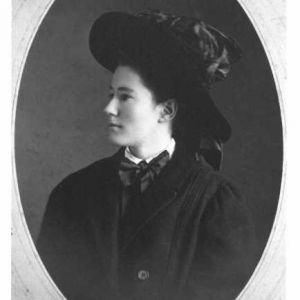
Portrait of Gertrude Menzies Harding from the past.

Worker of the Week: Gertrude Menzies Harding

By Collections blog

Worker of the Week is a series of blog posts which highlights the workers at H.M. Factory Gretna that our volunteers researched for The Miracle Workers Project. This project aimed to centralise all of the 30,000 people who worked at the factory during World War One and, although it may be over, our amazing research volunteers are continuing to uncover more stories about H.M. Factory Gretna workers to be added to this database. We are always looking to learn more about H.M. Factory Gretna workers. If you know anything about a H.M. Factory Gretna worker please feel free to get in touch with us by contacting info@devilsporridge.org.uk  

This week’s Worker of the Week, Alice Gertrude Menzies Harding, who was a suffragette! We’ve found a few inconsistences in information about Gertrude, so if you know more about her or are aware of any corrections we need to make please let us know. A huge thank you to all our research volunteers, as always!

Early Life

Alice Gertrude Menzies Harding (who was known as Gertrude) was born on 18th August 1889 in Welsford, New Brunswick Canada. She was the youngest of seven children to William Stening Harding and Jane ne Paschal. William was a farmer.

Suffragette

In 1912 she moved to London to become a suffragette. Gertrude was involved in carrying out and planning political protests. We’ve found suggestions that one of her protests involved some rather rare flowers at Kew Gardens! [1]

From 1914, Gertrude became the editor of ‘The Suffragette’ newspaper. [2] This was a underground newspaper focusing on the news and campaigns of the Women’s Social and Political Union (WSPU), of which Gertrude was a member.

It is worth noting that ‘The Suffragette’ newspapers usually tend to say that they are edited by Christabel Pankhurst on the front cover. This even includes ones from the time when Gertrude would have been working on them, like this one from the 14th August 1914 in the London Museum’s collection>

Maybe this could be because Christabel Pankhurst was more well known for her support of the women’s suffrage movement. Although Gertrude was actively involved in protests, Christabel Pankhurst was a co-funding member of the WSPU.

Interestingly, Gertrude is not the only H.M. Factory Gretna worker and suffragette to be involved in women’s suffrage newspapers! Helga Gill helped to distribute copies of Votes for Women to freshly released WSPU prisoners. Do you think they would have met each other at H.M. Factory Gretna?

Following this, in 1915 Gertrude moved to Paris. [2] But why exactly did she move to Paris? Well, she was working as private secretary to none other than Christabel Pankhurst. This happened the same year that ‘The Suffragette’ newspaper changed its name to become the ‘Britannia’ newspaper in October 1918. [3]

H.M. Factory Gretna

However, we have also found some records that suggest Christabel already returned to England in 1914 at the outbreak of World War One. [5] So perhaps, Gertrude was finishing off Christabel Pankhurst’s work in France, during her time in Paris?

According to the book ‘Rise Up Women: The Remarkable Lives of the Suffragettes’ by Diane Atkinson, Gertrude then went on to work at H.M. Factory Gretna. She is described as “providing social assistance to the women who worked there under terrible conditions.” [6]

Therefore, we believe that she could have possibly been a member of the Welfare Department during her time working at H.M. Factory Gretna. The welfare department were responsible  for looking after female munitions workers. If Gertrude had this role she may have also been involved in passing on complaints, comments or feedback from munitions workers and even inspecting rooms to make sure that they were up to standard. [4]

It is possible that fellow factory worker Helga Gill could have worked in the Welfare Department during her time at Gretna. Perhaps Gertrude and Helga could have possibly even worked together during their time at H.M. Factory Gretna, although we cannot know this for sure.

Later Life

In 1926, Gertrude returned to Canada from Liverpool. She was described as a social worker.

Gertrude died on 7th February 1977. She had returned to New Brunswick in Canada by this time.

***

[1] Welsford’s Gert Harding remembered as women’s suffrage pioneer – CBC news website – https://www.cbc.ca/news/canada/new-brunswick/ger-harding-womens-suffrage-1.3425155

[2] Gertrude Harding – Government of Canada’s website – https://www.canada.ca/en/women-gender-equality/commemorations-celebrations/women-impact/human-rights/gertrude-harding.html

[3] The British Newspaper Archive Blog Suffragette Newspapers – https://blog.britishnewspaperarchive.co.uk/2018/02/01/suffragette-newspapers/

[4] Guardian’s of Welfare: The Role of Female Superintendents in Munitions Factories – The Devil’s Porridge Museum – https://www.devilsporridge.org.uk/ladysuperintendents

[5] Christabel Pankhurst: Suffragette Leader – London Museum – https://www.londonmuseum.org.uk/collections/london-stories/christabel-pankhurst-suffragette-leader/

[6] ‘Rise Up Women: The Remarkable Lives of the Suffragettes’ by Diane Atkinson, published by Bloomsbury in 2018.

Find Alice Gertrude Menzies Harding online database entry by clicking here>

Gertrude Menzies Harding has a Wikipedia page, which can be found by clicking here>

Do you have a relative who worked at H.M. Factory Gretna? We would love to hear from you! Please feel free to contact us by emailing info@devilsporridge.org.uk. You never know maybe your relative feature in a future Worker of the Week blog post! You can also have a look at some more H.M. Factory Gretna workers on our online database here>

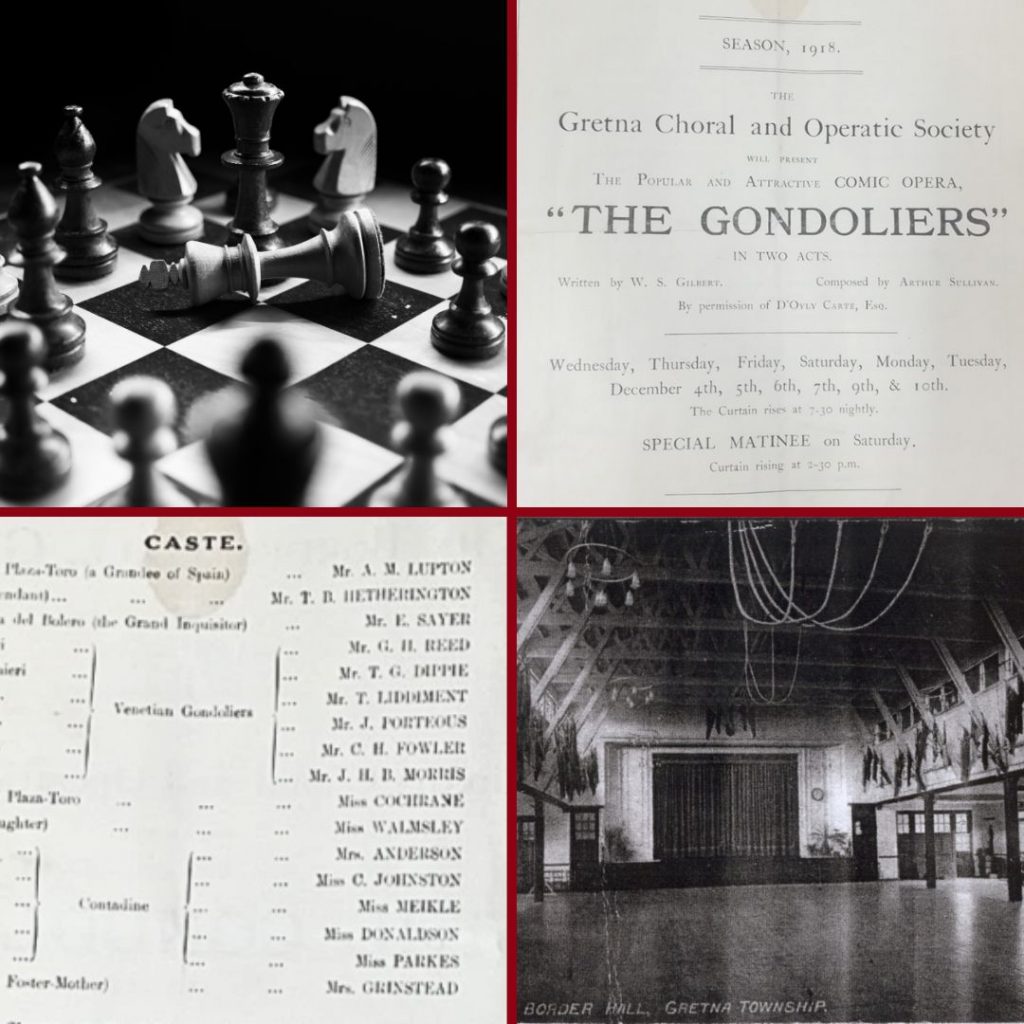
A game of chess, the inside of The Border Hall in Gretna, The front cover of a programme for a performance of "The Gondoliers" from 1918 and a cast from that programme featuring Mr A. M Lupton.

Worker of the Week: Alexander McKenzie Lupton

By Collections blog

Worker of the Week is a series of blog posts which highlights the workers at H.M. Factory Gretna that our volunteers researched for The Miracle Workers Project. This project aimed to centralise all of the 30,000 people who worked at H.M. Factory Gretna during World War One and, although it may be over, our amazing research volunteers are continuing to uncover more stories about H.M. Factory Gretna workers to be added to this database. We are always looking to learn more about H.M. Factory Gretna workers. If you know anything about a H.M. Factory Gretna worker please feel free to get in touch with us by contacting info@devilsporridge.org.uk  This week’s Worker of the Week is Alexander McKenzie Lupton, who took part in many concerts as a vocalist! A huge thank you, as always, to all our amazing research volunteers for helping to make this possible.

Early Life

Alexander was born on 22nd April 1872 in New Luce, Wigtown. He was born into the family Jane McKenzie and Robert Calvert Lupton.

His father, Robert worked as a parochial schoolmaster, inspector of poor and registrar. Accordingly, the family can be found living in a Schoolhouse in Inch, Wigtownshire in the 1871 census and appear still to be living here in 1881. We can safely assume that the families residence – where they lived for at least 10 years – may have been connected to Robert’s job.

Robert and Jane had a total of seven children, including Alexander, all born during their time living at the Schoolhouse. Sadly, not all of them survived infancy. Alexander would never have met his older sister Alexandrina Lupton, who was born in 1869 and died at the age of only 1 year old in 1870. There is a similarity in their names. Could Robert and Jane be honouring the memory of Alexandrina when they named Alexander?

Sadly, the youngest of Jane and Robert’s children, Robina Jane Lupton (born in 1877) died in 1879, aged only 1 year and 9 months old. Both Alexandria and Robina Jane are were buried at the Inch Old Churchyard in Wigtownshire.

By the 1891 census Alexander was living with his eldest sister Jessie Williamson Lupton (born in 1864) in Dundee. Jessie was a music teacher. During his time in Dundee, Alexander was a apprentice architect.

He had moved to live in Stirling to live with his eldest brother, Thomas Lupton (born in 1862) by the 1901 census. Thomas was a solicitor and Alexander is recorded as being an architect / measurer / surveyor and civil engineer.

Married Life

It was not long after this it seems that Alexander married Agnes Adam Ferguson (born in 1882) in Glasgow on 12th June 1903.

There first child was also born in 1903, but sadly died in 1904.

Agnes and Alexander had six more children (including some twins). After marriage they must have returned to Stirling, as this was were all 7 of their children were born. Perhaps, this was in part to be close to Alexander’s brother Thomas? Indeed one of the twins appears to have been named after him!

Chess boards and pieces in a collage of four photos.

Alexander seems to have liked chess.

Hobbies and Interests

Alexander and his brother Thomas keen chess players. They both took part in the Scottish Chess Tournament in 1905. One of them even won the junior championship in that tournament! They both also took part another chess tournament,  The Gentlemen’s Lightning Championship in 1908. So we think that the brother’s must have played plenty of chess games during there time in Sterling. We wonder who won the most often?

Chess was not Alexander’s only interest. According to The Great War Theatre’s website, there was an A.M. Lupton who was an engineer and well known in the amateur performance community in Stirling. [1] We think it’s more then likely that this A.M. Lupton could be Alexander McKenzie Lupton!

A.M. Lupton preformed “in concerts at the annual Royal Infirmary and a war fund benefit in Callander during May 1916,” according to The Great War Theatre’s website. [1] He is mentioned in several newspaper articles in the British Newspaper Archive as a vocalist in many different concerts. In one, Alexander is described as having a “full toned baritone voice.”

Indeed, it is Alexander’s interest in performance that led us to finding his connection to H.M. Factory Gretna. A newspaper article from the Stirling Observer in 1917 suggests that he is employed as a draughtsman at H.M. Factory Gretna for over a year.  [3] As the article puts it:

“Mr A. M. Lupton so long a leading figure in local musical and dramatic circles. For over a year he has been employed as a draughtsman at the Gretna Munitions works”

– The Stirling Observer, 1st May 1917.

This suggests he must have been working at H.M. Factory Gretna from at least some time in 1916. We know munitions production had began at H.M. Factory Gretna in 1916, but could Lupton have worked at the factory before this? If he was working as a draughtsman, he could have been helping create technical drawings for factory building or equipment in some way. However, we have not found any other evidence of exactly when Alexander started work at Gretna.

However, we do know his interest in performance continued after he began working in the factory. He became a member of The Gretna Choral and Operatic Society [3]. In fact, it appears that he may have been one of it’s founding members. [1]

The Gretna Choral and Operatic Society

The Gretna Choral and Operatic Society was one of the many social and recreational activities that H.M. Factory Gretna workers could get involved with. The recreational activities available at the factory were seen as being an important way to keep workers happy and therefore more productive (it also helped to keep the munitions workers out of mischief, but we do have some accounts of thefts made by the factory workers all the same!).

There was Social and Recreational Department which supervised all amusements and recreation facilities, which would have ranged from the tennis courts and the cinema, to perhaps even the factories women’s football teams like the Mossband Swifts! We know dances were held at The Border Hall in Gretna and this was also were The Gretna Choral and Operatic Society preformed.
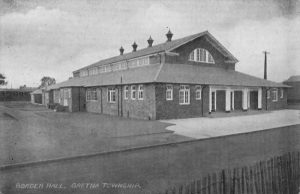
A large, wide, hall building with two rows of windows. In front of the building is a road. A driveway encircles the building. Text on the photo reads 'Border Hall, Gretna Township.' This photo is in black and white.

In The Gretna Choral and Operatic Society’s first performance, Lupton was the stage manager and played Sir Joseph Porter, First Lord of the Admiralty. This was for a production of ‘HMS Pinafore‘ which was staged in The Border Hall in April 1917. [1]

This was the first of many performances from The Gretna Choral and Operatic Society in Gretna’s Border Hall. Including ‘Les Cloches de Cornville’ and ‘Paul Jones the Solway Mariner.’ [2]

Inside The Border Hall in Gretna. This is an archive photo.

Inside The Border Hall in Gretna where Alexander would have preformed with The Gretna Choral and Operatic Society.

However, decision to demobilise  H.M. Factory Gretna (with demobilisation beginning on 6th December 1918) after the end of World War One, saw the start of the end for The Gretna Choral and Operatic Society and Lupton’s time with it. One last show was preformed at The Border Hall across several dates in early December 1918, with “special trains” put on locally for the show. [2] Factory Superintendent J C Burnham had silk version of the programme for this performance, which can be seen on display in The Devil’s Porridge Museum.

But what exactly was this last performance of? Well, it was of ‘The Gondoliers’ with “Mr A. M. Lupton” appearing at the head of the cast list in the programme as “The Duke of Plazo-Toro (a Grandee of Spain).”[2] Not only that, but it appears that Alexander was once again acting as the stage manager! His passion for theatrical performance and clearly hadn’t waned. Do you think his family ever came to watch his performances?
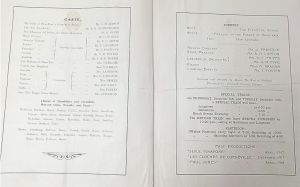
Paper programme for a performance of The Gondoliers at The Border Hall, Gretna in December 1918. A.M. Lupton appears as stage manager and in the cast list. There is also information about the special trains for the performance.

Inside of a paper programme from ‘The Gondoliers’ at The Border Hall in Gretna in 1918.
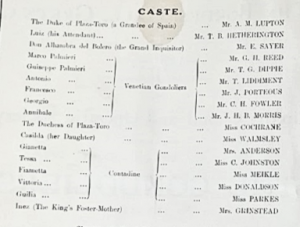
 

Cast list for the Gondoliers' featuring Mr A. M. Lupton.

Mr A. M. Lupton appears at the top of the cast list in the programme.

‘The Gondoliers’ is about two brother Venetian gondoliers, who have just chosen brides, only to find out one of them is the royal heir to the kingdom of Barataria. If you fancy watching this performance, at the time of writing, there is a version of Gilbert and Sullivan’s The Gondoliers on BBC iPlayer (although, we must disclose that this is a more modern production the the one Alexander was involved in at the Border hall over 100 years ago!). You can find The Gondoliers on BBC iPlayer by clicking here>
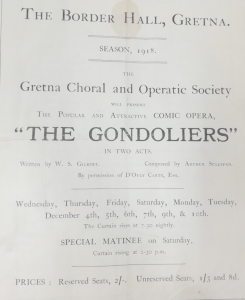
Front cover of a programme for the Gretna Choral and Operatic Society at The Border Hall Gretna in 1918.

The front of The Gondoliers programme.

After H.M. Factory Gretna

And what happened to Alexander after his time at the factory? Was this his last performance?

Of course not! When he returned to Stirling he was involved in the Stirling Choral Society, the Stirling Operatic Society and the Kinross – shire Amateur Dramatic Society.

In 1920 Alexander was an architect involved in a new housing scheme in Bonnybridge, but that was not the only event which happened in his life that year. More excitingly The Falkirk Electric Theatre changed its name to the Empire Theatre and was leased to none other than Alexander! During his time leasing the theatre he presented numerous acts from Europe and America.

Unfortunately, the good news did not last long. Sadly in 1930 Agnes died.

We next come across Alexander in 1932 when he married Elizabeth Campbell Doig in Dunbartonshire. Perhaps in the future, census records will be released which could show more of what happened to the family in the years after Agnes’ death?

In 1946 Alexander died in Old Kilpatrick, Dunbartonshire. This could be seen to suggest that maybe Elizabeth and Alexander stayed in Dunbartonshire, at least following their marriage.

***

Sources and Further Reading

[1] Cheerio Gretna: Theatre at the Factory by Stuart Gibbs (7th March 2018), The Great War Theatre’s website – https://www.greatwartheatre.org.uk/2018/03/406/

[2] Gretna Choral and Operatic Society, The Gondoliers programme, December 1918 from The Devil’s Porridge Museum’s archive.

[3] The Stirling Observer, 1st May 1917.


Read Alexander McKenzie Lupton’s online database entry>

Do you have a relative who worked at H.M. Factory Gretna? We would love to hear from you! Please feel free to contact us by emailing info@devilsporridge.org.uk. You never know maybe your relative feature in a future Worker of the Week blog post! You can also have a look at some more H.M. Factory Gretna workers on our online database here>

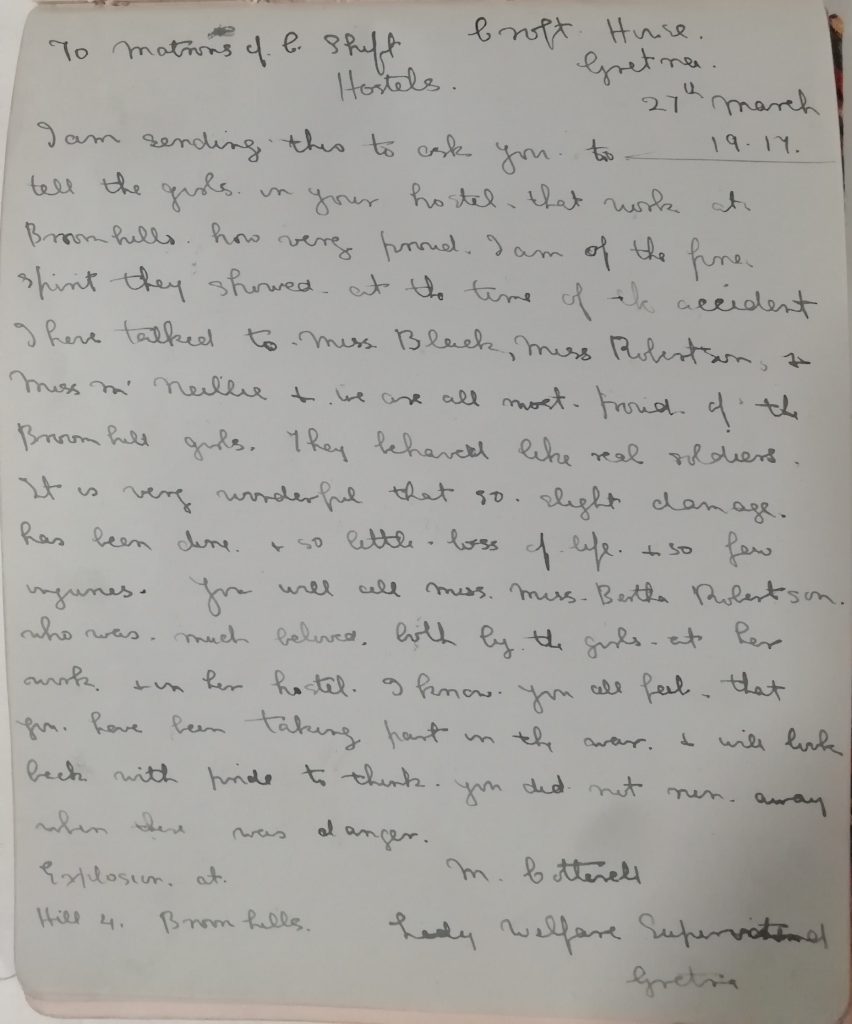
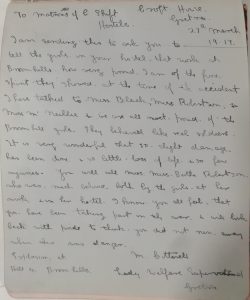
Entry from 1917 about an explosion at Broomhills at H.M. Factory Gretna from Lady Welfare Superintendent M. Cotterell from the autograph book of Gretna worker, Helen Jane Morrison.

Worker of the Week: Roberta Robertson

By Collections blog

Worker of the Week is a series of blog posts which highlights the workers at H.M. Factory Gretna that our volunteers researched for The Miracle Workers Project. This project aimed to centralise all of the 30,000 people who worked at H.M. Factory Gretna during World War One and, although it may be over, our amazing research volunteers are continuing to uncover more stories about H.M. Factory Gretna workers to be added to this database. We are always looking to learn more about H.M. Factory Gretna workers. If you know anything about a H.M. Factory Gretna worker please feel free to get in touch with us by contacting info@devilsporridge.org.uk  Today’s Worker of a Week is a bit of a sad one – we’re taking the time to remember Roberta Ewart Robertson who died at the factory.  Thank you to Nigel Crompton and our research volunteers!

Work at munitions factories like H.M. Factory Gretna could be very dangerous. Sadly, Fredrick Arthur Bird died in a workplace accident at the factory, and he wasn’t the only one. This week we’re remembering Roberta Robertson who died in an accident at the factory.

Early Life

Roberta was born on 18th July 1896 into the family of William and Priscilla Robertson, who were living at English Street in Dumfries.

According to the 1901 census, Joseph, Roberta’s eldest brother had moved away after securing employment working as a railway locomotive cleaner in Ayrshire. Roberta had a total of 6 siblings, including Joseph. Her father, William originally worked as a grain carter, later becoming a warehouse man in a grain store. Interestingly, several of Roberta’s brothers had extensive careers in the grain industry in Scotland and Canada when they were older.

By the 1911 census, the family were still living in Dumfries. Roberta was employed full time as a machinist in tailoring and her elder sister, Maggie Jane, was a dressmaker.

H. M. Factory Gretna & the Accident

We do not know exactly when Roberta began to work at H.M. Factory Gretna. Perhaps she was lured by the promise of better wages? However, we do know that her clock number was 16046.

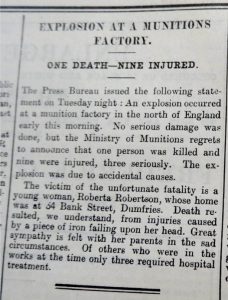
On 27th March 1917, in the early hours of the morning within N/G Hill No4, Broomhills a charge of nitro glycerine started fuming. Before any attempts were made to reduce the risk, the charge was seen to be in flames. Alarms were sounded, evacuation began, but the charge exploded. Roberta was killed by flying debris. Serval other munitions workers were injured, but not fatally.

Meanwhile, the official news report report about the explosion did acknowledge Roberta’s death and the other people who were injured. However, it does highlight that the explosion caused “no serious damage.” It seems highly likely they were trying to play down the impact of the explosion as much as possible. Perhaps the only reason they reported on it is people would have heard and been concerned about what happened; reporting on the explosion could help to dispel any rumours of an attack and clarify that it was only accident.

The accident seems have been reported on in serval newspapers, including local newspaper, The Annandale Observer, as seen below [2].

Newspaper article about an "Explosion at a Munitions Factory." This is about the explosion which caused Roberta Robertson's death.


The impact of the explosion and the loss of Roberta must have been keenly felt by her fellow munitions workers, especially those who knew her and also worked at Broomhills.

Although we can’t know for sure that it was the same explosion, a relative of munitions worker Sarah Thorburn Irvine Anderson shared that Sarah swapped shift with another supervisor on “the day of the big explosion.” The other supervisor died in the explosion. Sarah survived as she had swapped her shift. [3]

However, we know there may have been at least one other explosion at H.M. Factory Gretna. In May 1917, Martha Hannah Beech sadly died as result of injuries from an explosion at a munitions factory. [6]

In an autograph book belonging to worker Helen Jane Morrison, we have found a page were the Lady Welfare Superintendent of the factory, Mable Cotterell appears to write about an “explosion at Hill 4 Broomhills.” She has dated her entry 27th March 1917, the same day as this accident. In it she takes the time write “You must all miss Miss Bertha Robertson who was much beloved both by the girls at her work and her hostel.” [4] Is it too much to think that Bertha could be a nickname for Roberta?

The bravery of girls that work at Broomhills is also commended were Miss Cotterell, appears to have written of “how very proud I am of the fine spirt they showed at the time of the accident” and “we are all very proud of the Broomhills girls. They behaved like soldiers.”[4]

Interestingly, she seems does seem to echo the sentiment of the newspapers when she writes “it is wonderful that so slight damage has been done and so little loss of life and so few injuries.” It is important to consider that Miss Cottrell was employed by the Ministry of Munitions to set the Welfare Department at Gretna. She used to do administrating and filing records for the female workers, as well as being involved in organising social and sporting events, so perhaps she felt this was the best way to keep the girls in good spirts. [5] Either way it is hardly likely that she would contradict her employer or the official news reports, regardless of the amount of damage caused. It’s likely we’ll never know for sure exactly how much was caused.

Her entry into the autograph book does seem to be directed to hostel matrons. Maybe this entry has been copied from a letter or note sent out by Miss Cortterell  to hostels after the accident? What do you think?

Entry about an explosion at Broomhills at H.M. Factory Gretna from Lady Welfare Superintendent M. Cotterell from the autograph book of Helen Jane Morrison.

Entry about an explosion at Broomhills at H.M. Factory Gretna from Lady Welfare Superintendent M. Cotterell from Helen Jane Morrison’s autograph book.

Remembering Roberta

A plot was purchased in St Michael’s Cemetery, Dumfries on 28th March and Roberta was laid to rest on 31st March 1917. At a later date, her headstone was engraved ‘died in the service of her country’ and then underneath ‘Erected by fellow workers and friends – HM Factory Gretna’. She was clearly well thought of at H.M. Factory Gretna.

The Ministry of Munitions records indicate that £100 compensation was paid to the Roberta’s family.

Roberta’s name appears on not one but two war memorials. One in Gretna Parish Church and on the main Dumfries War Memorial.

***

Sources and Further Reading

[1] Sixteenth Report of the Standing Committee Appointed by the Minister of Munitions to Enquire into the Cause of Explosions at Government and Controlled Factories, 1917.

[2] The Annandale Observer, 30th March 1917.

[3] Sarah Thorburn Irvine Anderson’s online database entry >

[4] Lady Welfare Superintendents entry into Helen Jane Morrison’s autograph book.

[5] Mable / Mayble Cotterell’s online database entry>

[6] Martha Hannah Beech’s online database entry>

Roberta Ewart Robertson’s online database entry> 

Do you have a relative who worked at H.M. Factory Gretna? We would love to hear from you! Please feel free to contact us by emailing info@devilsporridge.org.uk. You never know maybe your relative feature in a future Worker of the Week blog post! You can also have a look at some more H.M. Factory Gretna workers on our online database here>
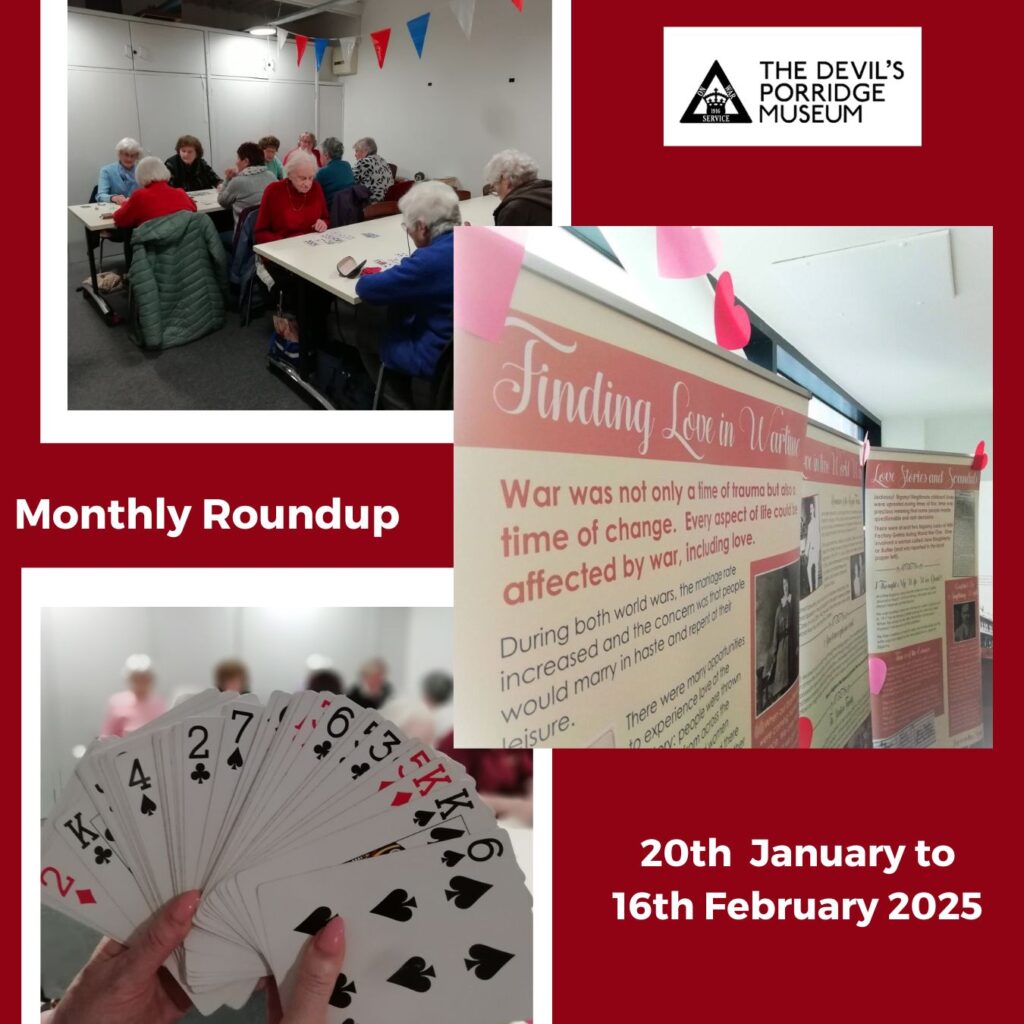
A collage of photos of The Devil's Porridge Museum's Cordite Club and Love in Wartime exhibition. Some text reads "Monthly Roundup 20th January to 16th February 2025.

Monthly Roundup: 20th January to 16th February 2025

By Archive

It’s time for our latest Monthly Roundup: 20th January to 16th February 2025. This Roundup covers the return of Cordite Club and our annual Burns Supper!

Monday 20th January 2025

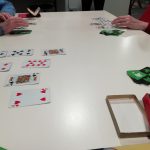
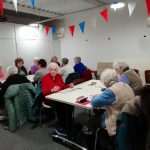
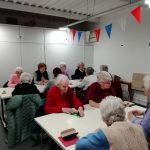
The start of this Monthly Roundup saw the Cordite Club return to The Devil’s Porridge Museum after a break for the festive season. It was fantastic to have them back!

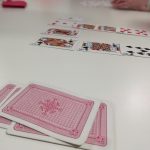
This week they played bingo! If your interested in learning more about Cordite Club please click here>

Below are some photos from this week’s Cordite Club.

***

Tuesday 21st January 2025

Today marked our first Youth Council meeting of 2025. It was exciting to discuss some interesting ideas for activities for the start of 2025.

***

Friday 24th January 2025

On Friday 24th January we had our Burns Supper planned. Unfortunately, Storm Eowyn had other ideas and we were forced to cancel this event to protect staff, visitors and volunteers. We would like to thank everyone who took the time to book this event, as well as all those who were already helping us prepare for it and we’re sorry for any disappointment this has caused. Refunds have now been issued to everyone who booked tickets.

We will hoping run this event again next year, so long as we can ensure the safety of everyone involved.

***

Wednesday 30th January 2025

We were delighted to have our Curator, at a meeting at the local job centre today to share some information about our volunteer opportunities. We have lots of volunteering opportunities which can help you build your confidence, experience and improve your CV! Read more about volunteering with us by clicking here>

If your aged 16 to 24 years old, why not join our Museum Mentorship Programme? You will be able to gain hands on experience in your chosen volunteer role with support, guidance and training from an experienced mentor. Find out more about our Museum Mentorship Programme by clicking here>

***

Monday 3rd February 2025

Cordite Club were back in The Devil’s Porridge Museum again today. This week they were treated to a belated Burns Supper!

Our Cordite Club also played card bingo, competed in a Robert Burns themed quiz and enjoyed some chair aerobics. Below are some photos from today’s Cordite Club.

Today also saw the return of our Arts and Crafts club! This week they were making paper dancing teddy bears!

If you want to learn more about Arts and Crafts club, please click here>

Below are some photos of our Arts and Crafts club.


***

Monday 10th February 2025

Arts and Crafts Club were back in The Devil’s Porridge Museum again today. It’s lovely to have them and always very exciting to see what they will make!


***

Thursday 13th February 2025

We were delighted to welcome people to a community gathering to share love stories today. Our ‘Love in Wartime’ exhibition was also on display for people to look at.

A huge thank you to everyone who helped make this event possible and everyone who joined us for this!

Below is one photo from this event, but we are hoping to add more very soon!

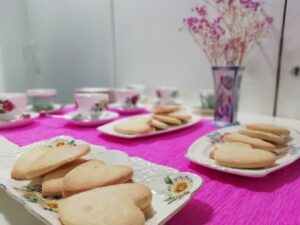
Some heart shortbread arranged on plates in The Devil's Porridge Museum's Education Room.

***

Saturday 15th February 2025

We’re proud to be taking part in Tourmaline and the Museum of Marvels trail, which is organised by Kids in Museums and Little Tiger starting from Saturday 15th February 2025. This is a free activity with admission into The Devil’s Porridge Museum. You can get involved with this trail at The Devil’s Porridge Museum until Sunday 23rd February 2025.

Learn more about Tourmaline and the Museum of Marvels trail by clicking here>

***

That’s all for this Monthly Roundup! We have some more exciting events coming up as part of our February Mid-Term Programme 2025, which you can learn more about by clicking here>

If your wondering what happened in our last Monthly Roundup click here>

Worker of the Week: Bertha and George Bradley

By Collections blog

Worker of the Week is a series of blog posts which highlights the workers at H.M. Factory Gretna that our volunteers researched for The Miracle Workers Project. This project aimed to centralise all of the 30,000 people who worked at H.M Factory Gretna during World War One and, although it may be over, our amazing research volunteers are continuing to uncover more stories about H.M. Factory Gretna workers to be added to this database. We are always looking to learn more about H.M. Factory Gretna workers so if you know anything about a H.M. Factory Gretna worker please feel free to get in touch with us by contacting info@devilsporridge.org.uk  We’ve all eaten potatoes, but this week’s married couple for Worker of the Week, Bertha and George Bradly, were once accused of stealing them!

Early Life

George Frederick Bradley was born on 25th November 1882 at Gargrave, North Yorkshire. His parents were James and Mary Ann Bradley. His father was described simply as a ‘worker’ when George was baptised in 1883 at Carleton in Craven. Not much more about George has been found until his marriage to Bertha in 1904.

A couple of years after George’s birth, Bertha Thomas was born in 1884 in Nelson, Lancashire. She was the youngest of 7 children to her mother Sarah and her father, also called James. This James worked as a worked cotton weaver.

In 1891, Bertha and family were still living in Nelson, Lancashire. However, sadly Sarah is now a widow.

By 1901, Bertha is working as a draper’s shop assistant.

Marriage

On 16th January 1904 Bertha married George Frederick Bradley at Burnley Parish Church.

After his marriage, George seems to have been involved in some criminal behaviour. In 1906, George (who was described as a coachman) was tried at Preston Court and imprisoned for 4 months with hard labour. What had George done? Well he’d stolen jewellery and clocks worth more than… £5! Of course,  £5 in 1906 could now be worth around £513.76 (as of October 2024) according to an approximate estimate from the Bank of England’s Inflation Calculator.[1]

By the 1911 census, Bertha and George are living in four rooms Nelson in Lancashire and now have 2 children. George is working as a carter.

H.M. Factory Gretna

Although, it’s impossible to place how exactly or if Bertha and George worked at H.M. Factory Gretna, we have found record of them both living at “West 14 Township Gretna” in 1917. It is likely that they might have moved to work at H.M. Factory Gretna, as many people moved to Gretna to do this. Perhaps George continued to work as a carter in some from during his time at Gretna. Unfortunately, we may never know for sure, but what do know about is a potato plot, reported in The Dumfries and Galloway Standard. [2]

So what did the potato plot entail? According to The Dumfries and Galloway standard George and Bertha were accused with pinching:

  • Approximately 10 stones of potatoes;
  • About 3 stones of carrots;
  • Around 3 lbs of beetroot;
  • 3 leeks;
  • and the small straw bag.

All from the Ministry of Munitions at the central cooking kitchen at Gretna township between the 3rd and 5th May 1906! But what exactly happened?

From what the Dumfries and Galloway Standard newspaper reported that theft seemed to have been happening in the central kitchen for some time. With suspicions running high, attention was drawn towards Bertha and George. What sort of suspicious behaviour had to cast them as a suspect remains a mystery to us (perhaps someone glimpsed George smuggling carrots out of the kitchen, or three leeks in his shoes!), but we do know a keen watch was started to catch the food thief.

Just as all the people in the kitchen were tucking into their breakfast one morning, Bertha and George were alleged to have sprung into action. A bag of around 10 stones potatoes was mysteriously taken from the kitchen. Only for them – as in Bertha and George, not the potatoes – to be suspiciously seen entering the stable shortly after being in the kitchen.

Following this, another carter (and possible accomplice) John Irving found a mysterious bag of around 10 stones of potatoes in a lorry and took it. Apparently, he thought the bag contained carrots, so John put it in the stable. Perhaps, in John’s instance it was simply a case of being in the wrong place at the wrong time. John was from Cannobie and had served with the Lanarkshire Yeomanny. At the time of the incident he had a wife and six children. Although, the newspaper records John having no intention of taking the potatoes for his own personal use he did indeed move them to the stable…

Either way, from the newspapers account we know that George and John, or “the male accused pleaded guilty to taking ten stones of potatoes, but the female accused pleased not guilty.” “The Fiscal accepted this plea, and deserted the diet against the female accused.”[2]

The final outcome was that those accused “must each pay a fine with the alternative of fourteen days imprisonment.” The fact that the accused “had good character” and “were perfectly well aware that they ought not to help themselves to things without permission” is also mentioned. [2] Perhaps, no knowledge of George’s previous jewellery heist and resulting imprisonment was known.

Lots of potatoes. This photo is from Canva.

As printed in The Dumfries and Galloway Standard:

“POTATO STEALERS FINED. George Frederick Bradley, foreman carter, and Bertha Thomas or Bradley, his wife, both residing at West 14, Township, Gretna; and John Irving, carter, Rose Cottage, Gretna Green, were charged with having stolen ten stones or thereby of potatoes, three stones or thereby of carrots, three lbs. thereby of beetroot, three leeks, and a small straw bag, the property of the Ministry of Munitions, between 3d and 5th May, the vegetable store of the central cooking kitchen at Gretna township. Mr John M. Gaining, solicitor, appeared on behalf of the accused. He stated that the male accused pleaded guilty to taking ten stones of potatoes, but the female accused pleaded not guilty. The Fiscal accepted this plea, and deserted the diet against the female accused. The Fiscal stated that for some time past a good deal of pilfering had been going on at the central cooking kitchen, and it was suspected that the two accused had something to do with it. A watch was kept, and on the day in question the accused were seen coming into the stable after having been at the kitchen. Irving took a bag from the lorry, and it was found that it contained about ten stones of potatoes. The employees in the kitchen had been engaged at breakfast, and the accused had seized the opportunity of taking this bag of potatoes. Bradley was earning £2 per week, and Irving was getting 48s. Mr Raining stated that the accused thought it was carrots, and they took for the purpose of it in the stable. Irving was a married man with a wife and six children. He was a native of Canonbie. and had served with the Lanarkshire Yeomanry. The accused had no intention of taking these potatoes for their own use. The Sheriff said that taking it that the accused had had good character far. they were perfectly well aware that they ought not to help themselves to things without permission. They must each pay a fine with the alternative of fourteen days’ imprisonment.”

–  The Dumfries and Galloway Standard, Saturday 2nd June 1917

Life After H.M. Factory Gretna

We know that George and Bertha must have emigrated to New Zealand some point after their time at Gretna.

On 22nd June 1944, George died aged 61 at Hawkes Bay in New Zealand.

Bertha lived to 88 and died on 26th October 1971 also in Hawkes Bay in New Zealand.

***


[1] Bank of England’s Inflation Calculator website – https://www.bankofengland.co.uk/monetary-policy/inflation/inflation-calculator

[2] The Dumfries and Galloway Standard, Saturday 2nd June 1917

Bertha Bradly’s online database entry>

George Frederick Bradley’s online database entry>

Do you have a relative who worked at H.M. Factory Gretna? We would love to hear from you! Please feel free to contact us by emailing info@devilsporridge.org.uk. You never know maybe your relative feature in a future Worker of the Week blog post! You can also have a look at some more H.M. Factory Gretna workers on our online database here>
Poster for Love in Porridge talk at The Devil's Porridge Museum on Thursday 13th February 2025 at 7pm. This will be a community gathering to share love stories including those from H.M. Factory Gretna. Booking is essential. You can book on The Devil's Porridge Museum's website or by emailing education@devilsporridge.org.uk

Valentine’s Talk: Love and Porridge

By Archive

Thursday 13th February 2025

7pm

A community gathering to share love stories including some from H.M. Factory Gretna.

You will also be able to enjoy our ‘Love in Wartime’ exhibition which will be on display.

Tea or coffee and biscuits will be available after the talk.

A free event. Visitors and families of all ages are welcome to attend!

Booking is essential and places are limited.

You can book your place by emailing education@devilsporridge.org.uk or pressing ‘Book Now’ and selecting Love and Porridge.

Mid-Term Holiday Programme for 2025 at The Devil's Porridge Museum 2025 poster. It features a selection of four free activities for young people at The Devil's Porridge Museum.

Mid-Term Holiday Programme 2025

By Archive

We have an exciting range of FREE activities available for all the Family as part of our Mid-Term Holiday Programme 2025.


Mid-Term Crafting Adventures for Toddlers.

Poster for a Free Mid-Term Crafting Adventures for Toddlers Activity at The Devil's Porridge Museum on Wednesday 19th February from 11am to 1pm. No booking is required, but please be aware that admission prices for The Devil's Porridge Museum do apply to anyone wishing to look around The Devil's Porridge Museum.

Wednesday 19th February 2025

11am to 1pm

FREE! (Admission charges do still apply for anyone wishing to look around The Devil’s Porridge Museum).

Children can enjoy hands-on crafting with a variety of materials, creating colourful masterpieces to take home. It’s a wonderful opportunity for toddlers to develop their fine motor skills while having fun in a relaxed, friendly environment.

Parents or carers are kindly asked to stay and help guide their little ones through the crafting fun, offering a helping hand along the way!

No booking required – just drop in and let the crafting fun begin!


Sewing Hope: Quilts for Climate Change.

Sewing Hope: Quilts for Climate Change poster for a free workshop on Thursday 20th February 2025. This activity is suitable for all the family. Help us make a quilt to raise awareness of climate change & build hopes for the future!Part of Climate Change for All, a public engagement project exploring environmental sustainability in Scotland, delivered by National Museums Scotland and funded by the Scottish Government’s Climate Engagement Fund. No booking is required for this free activity, but please be aware that admission prices for The Devil's Porridge Museum do apply to anyone wishing to look around The Devil's Porridge Museum.

Thursday 20th February 2025

11am to 1pm

FREE! (Admission charges do still apply for anyone wishing to look around The Devil’s Porridge Museum).

Help us make a quilt to raise awareness of climate change & build hopes for the future! This activity is suitable for all the family.

Part of Climate Change for All, a public engagement project exploring environmental sustainability in Scotland, delivered by National Museums Scotland and funded by the Scottish Government’s Climate Engagement Fund.

No booking required – just drop in!

Please be aware that this is a drop in activity and we only expect people to stay for 1 hour or until they have completed their quilt. This will help us make sure that everyone has the opportunity to craft a quilt and have fun!


Mid-Term Warhammer Workshop: Build, Battle, and Conquer.

Mid-Term Warhammer Workshop: Build, Battle and Conquer. This will be on Thursday 20th February from 3pm to 4pm. To book your place please email: education@devilsporridg.org.uk

Thursday 20th February 2025

3pm to 4pm

FREE! (Admission charges do still apply for anyone wishing to look around The Devil’s Porridge Museum).

Whether you’re a seasoned player or new to the game, this session offers the perfect opportunity to learn the basics of Warhammer, build your own army, and dive into thrilling battles. With guidance from experienced players, you’ll explore the rich world of Warhammer, from painting miniatures to mastering tactics on the battlefield.

All materials will be provided – just bring your enthusiasm and get ready for an epic adventure!

To book please contact: education@devilsporridge.org.uk


Creative Crafts Drop-In.

Poster for a Creative Craft Drop-In activity for 6 to 11 year olds at The Devil's Porridge Museum on Friday 21st February 2025 from 11am to 1pm. No booking is required for this free activity, but please be aware that admission prices for The Devil's Porridge Museum do apply to anyone wishing to look around The Devil's Porridge Museum.

Friday 21st February 2025

11 am to 1pm

FREE! (Admission charges do still apply for anyone wishing to look around The Devil’s Porridge Museum).

Join us for a fun and creative drop-in craft workshop at The Devil’s Porridge Museum! Take what you make home with you!

This hands-on activity is perfect for children aged 6 to 11 years old.

No booking required – just drop in and let the crafting fun begin!

Please be aware that this is a drop in activity and we only expect people to stay for 30 minutes. This will help us make sure that everyone has the opportunity to craft something and have fun!


Poster for Kids in Museums' and Little Tiger's Tourmaline and the Museum of Marvels Trail.

And that’s not all happening as part of our Mid-Term Holiday Programme 2025! From Saturday 15th February to Sunday 23rd February 2025 you can take part in  Tourmaline and the Museum of Marvels trail this is free with admission into The Devil’s Porridge Museum. Learn more about Tourmaline and the Museum of Marvels trail by clicking here>

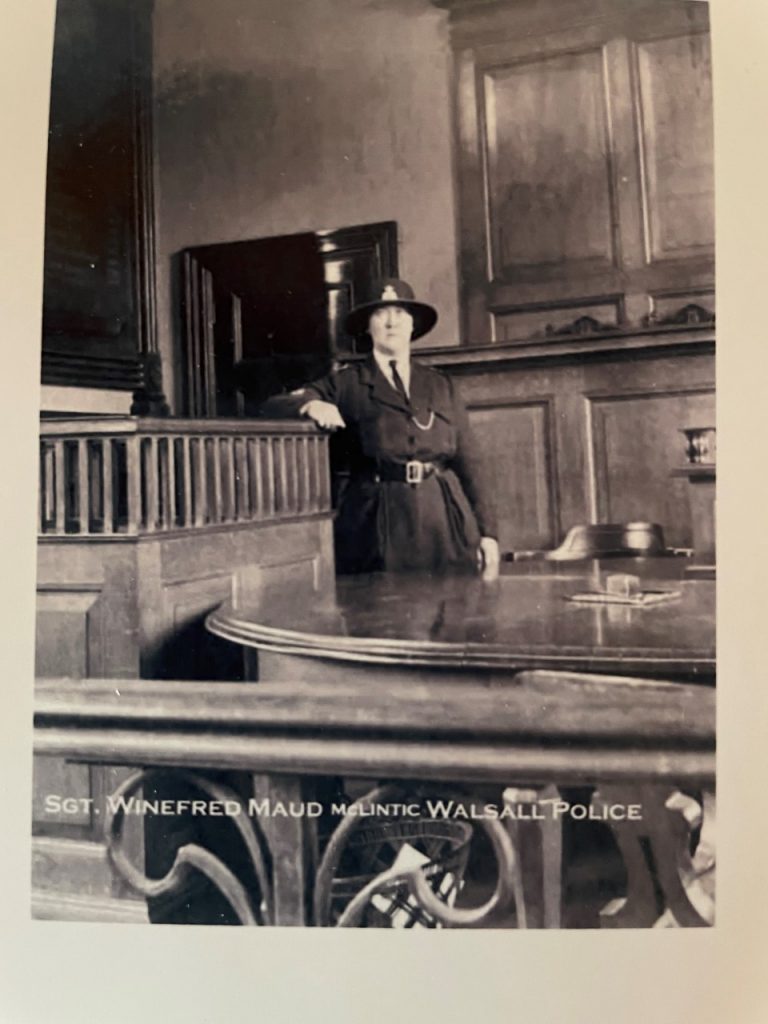
A photo of Winifred Maud McLintic in her police uniform from when she worked at the Walsall Police.

Worker of the Week: Winifred Maud McLintic

By Collections blog

Worker of the Week is a series of blog posts which highlights the workers at H.M. Factory Gretna that our volunteers researched for The Miracle Workers Project. This project aimed to centralise all of the 30,000 people who worked at H.M. Factory Gretna during World War One and, although it may be over, our amazing research volunteers are continuing to uncover more stories about H.M. Factory Gretna workers to be added to this database. We are always looking to learn more about H.M. Factory Gretna workers so if you know anything about a H.M. Factory Gretna worker please feel free to get in touch with us by contacting info@devilsporridge.org.uk  This week’s Worker of the Week is Winifred Maud McLintic a member of the Women’s Police Force. A huge thank you to Nigel Crompton for his research and Winifred’s great-niece for kindly sharing photos and further information with us! 

*** Please be aware this blog post includes some information about shell shock and historic perspectives on mental health.***

Early Life

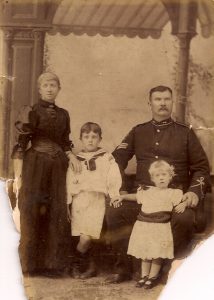
Winifred Maud McLintic was born on 16th February 1891. Her older brother, Francis was born on 4th August 1897 in Valetta, Malta. It is likely that Winnifred’s early years were also spent in Malta with her brother and parents James and Catherine. Her farther, James McLintic was a NCO in the Royal Garrison Artillery, so it is likely that the family lived in British Army accommodation on Malta.

A black and white photo of a family from the past. From left to right is Catherine Reardon, Francis Thomas McLintic as a boy, his father Francis James McLintic and his young daughter Winifred Maud McLintic.

Winifred and her brother with her parents. A huge thank you to her relative for kindly sharing this photo with us.

By 1903 part of the family must have been living in or near Beauly, North Inverness. This is where Winifred’s mother Catherine was buried in 1903.

On the 29th May 1906, Francis had enlisted in Inverness, joining the Cameron Highlanders 5th battalion.

Meanwhile, the first tangible evidence for Winifred being in Great Britain is the Scottish 1911 census where she is shown as living at 30 Colinton Road, Morningside, Edinburgh, employed by the Ford Sisters as a housemaid and waiting at table.

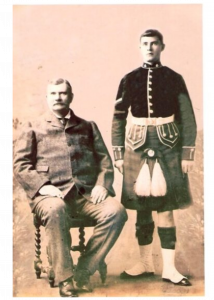
Francis Thomas McLintic

A black and white photo of Francis Thomas McLintic in his uniform and his father.

Francis Thomas McLintic and his father. A huge thank you to Winifred’s great-niece for sharing this photo with us.

On the 10th May 1915, the Cameron Highlanders the 5thbattalion landed in Boulogne, France and Francis discharge certificate states that this was his last entry into conflict. He was discharged in  on 1st March 1918 in Perth after serving 11 years 277 days. According to his discharge certificate this is “in consequence of being no longer physically fit for War Service.” In a casualty record issued in 1915 he is referred to as “F McLintie” and as “suffering from shock shell.”

According to The National Archives website, the term shell shock would have been relatively new when Francis was given this diagnoses, as it was only coined by medical officer Charles Myers in 1915 [1].  As the Imperial War Museum explains here, World War One was the first time “psychological trauma of warfare was formally recognised” [2], meaning that it was misunderstood by many people. At the time it could be wrongly seen as sign cowardice [3] and unfortunately it appears as though that Francis family at the time may have felt this. Francis great-niece shared with us that she had been told that Francis had died in the war.

However, Francis’ great-niece’s research that she has kindly shared with us has uncovered Francis’ true story, and allowed us to share it.  Although, she shared with us that, after Francis’ discharge “he no longer knew his wife and family and spent from 1916 to 1963 in hospitals and died in Edinburgh in the care of the Little Sisters of the Poor,” he is still remembered through the research and actions taken by his great-niece.

Winifred at H.M. Factory Gretna

Winifred seemed to join the Women’s Police force at Gretna in June 1918, but we have not located any address for Winifred during this time. She seems to have worked here until September 1919. We know the Women’s Police Force at Gretna had many duties such as searching munitions workers on the way into the factory to ensure they were not smuggling any materials, such as matches, hair pins or metal knitting needles in to the factory. They were working with explosive materials at H.M. Factory Gretna items like these, or any metal items could cause an explosion. If munitions workers were found with these items, the offending article would be taken from the worker and they would be fined. In one instance we are aware of metal buttons even were cut off a munitions worker’s corset!

After H.M. Factory Gretna

Following her time at Gretna, Winifred joined the Walsall Borough Police in 1921 according to West Midlands Police records. There are various local newspaper articles from Walsall that record some of Winifred’s causes. There is one were a 13 year old is caught wearing stolen clothing from a second hand shop, only for more  missing items from that very same shop to be found when Policewoman McLintic called at her and her stepmother’s home! According to another article she once had to “knock down” the son of a women she was arresting for being drunk and disorderly when he was trying to help his mother escape!

A photo of Winifred Maud McLintic in her police uniform from when she worked at the Walsall Police.

Here is a photo of Winifred Maud McLintic during her time in working at Walsall. Thank you to Winifred’s great-niece for kindly sharing this photo with us.

In December 1930 she resigned from her work in the police giving one months notice. The timing of this could be seen to suggest that she left to get married the following month. On the 24th  January 1931 to Winifred married George Ernest Crook. George was a fellow Walsall police officer who rose to the rank of inspector. They had two children.

Interestingly, the Walsall Borough magistrates in 1935 heard a case of theft during which evidence was given by a Policewoman McLintic. Could Winifred have later gone back to working in the police force? Or could it have been the result of one of her many past cases? Winifred’s police record does not show her re-joining the force and we’ve found no record to support this, but it’s not impossible. It would lovely to think that married family life didn’t stop Winifred’s police work! At the very least we know she may have been involved in one more case.

George & Winifred later moved to a bungalow in Solihull.  It was here that Winifred passed away on 16th December 1981.

***

Sources and Further Reading

[1] Shell Shock Cases, The National Archives Website – https://www.nationalarchives.gov.uk/education/resources/medicine-on-the-western-front-part-two/shell-shock-cases/#:~:text=The%20term%20was%20coined%20in,fire%20were%20just%20as%20traumatised.

[2] Voices of the First World War: Shell Shock, Imperial War Museum website – https://www.iwm.org.uk/history/voices-of-the-first-world-war-shell-shock

[3] Shell Shock, BBC Inside Out archived website – https://www.bbc.co.uk/insideout/extra/series-1/shell_shocked.shtml

Find Winifred Maud McLintic’s online database entry by clicking here>

Do you have a relative who worked at H.M. Factory Gretna? We would love to hear from you! Please feel free to contact us by emailing info@devilsporridge.org.uk. You never know maybe your relative feature in a future Worker of the Week blog post! You can also have a look at some more H.M. Factory Gretna workers on our online database here>
Poster for Kids in Museums' and Little Tiger's Tourmaline and the Museum of Marvels Trail.

Tourmaline and the Museum of Marvels Trail

By Archive

From Saturday 15th February to Sunday 23rd February 2025

Free with Admission into The Devil’s Porridge Museum.

The Devil’s Porridge Museum is proud to be taking part in Kids in Museums’ and Little Tiger’s Tourmaline and the Museum of Marvels trail!

From Saturday 15th February to Sunday 23rd February 2025 join us for the Tourmaline and the Museum of Marvels Trail, organised by Kids in Museums and Little Tiger. The national trail for families is inspired by Tourmaline and the Museum of Marvels by Ruth Lauren; a fun, feminist adventure series for children aged 9 – 12.

Tourmaline’s strange new magical powers are causing chaos and she desperately wants to know how to control them. When she receives a mysterious postcard promising her answers, she sets off on an unforgettable adventure to the Museum of Marvels.

Pick up a free activity sheet to join in at  The Devil’s Porridge Museum. Search for Tourmaline, her friends and an assortment of magical objects hiding in the museum. Complete the spotter trail and get a free Tourmaline sticker!

Children can also design their very own Museum of Marvels. Three winning designs will win a signed Tourmaline book bundle and a National Art Pass (plus kids) courtesy of Art fund; giving one adult plus children under 16 free entry to hundreds of museums, galleries and historic houses across the UK as well as 50% off major exhibitions!

Full competition terms and conditions>

Admission into The Devil’s Porridge Museum is required to take part in this activity. Our usual opening hours and prices do apply.

Graphic of Worcester sauce, corned beef, honey and cheese.

Worker of the Week: Minnie Turnbull

By Collections blog

Worker of the Week is a series of blog posts which highlights the workers at H.M. Factory Gretna that our volunteers researched for The Miracle Workers Project. This project aimed to centralise all of the 30,000 people who worked at H.M. Factory Gretna during World War One and, although it may be over, our amazing research volunteers are continuing to uncover more stories about H.M. Factory Gretna workers to be added to this database. We are always looking to learn more about H.M. Factory Gretna workers so if you know anything about a H.M. Factory Gretna worker please feel free to get in touch with us by contacting info@devilsporridge.org.uk  This week’s Worker of the Week, Margaret Bridilla Turnbull was involved in a theft at a local shop in Gretna! A huge thank you to research volunteer Marylin all her research which has made this possible.

Early Life

Margaret Bridilla Turnbull, known as Minnie Turnbull, was born in 1899 in Earsdon, Northumberland. Her mother, Mary Anne Turnbull (nee Christopher), worked as a charwomen, while her farther, John Robert Turnbull, was a tug boat man.

In the 1901 census, the family is living in a house in Bedford Street, North Shields, which is shared with 3 other families. Although, Mary is listed as being married, her husband is not present. We know he later worked with boats as a tug boat man in the 1911 census, so perhaps he could be away working on a boat, but it is impossible to know for sure.

By the 1911 census, Mary has died, leaving John Turnbull widowed and working as a tug boat man. Minnie is one of 10 children with 9 surviving in the family, which has now moved to another address in Little Bedford Street, North Shields were they live in three rooms.

H. M. Factory Gretna

In 1917 we know that 18 year old, Minnie Turnbull was employed as a munitions worker at H.M. Factory Gretna thanks to the newspaper report of some rather nefarious behaviour at a Gretna “fried fish” shop. But what exactly happened? Well, one winter Sunday evening the chip shop was particularly busy with munitions workers from the factory. Suddenly, the lamp in the shop got blown out and the chip shop was plunged into darkness. It was only in the following morning that the shop owner, Baldi Toni, found something missing! But what was missing? Money from the till? Fish? The lamp? None of the above, in fact what had vanished was:

  • 9 cheese plates;
  • 2 cans of corned beef;
  • 6 boxes honey;
  • and 3 bottles of Worcester sauce.

Does anyone else wonder what they were planning to use this rather bizarre assortment of food for?

Food at H.M. Factory Gretna

We know that hostel matrons at H.M. Factory Gretna could provide their boarders with Borders Meal Tickets that could be exchanged for food in the factory’s messrooms. Each ticket could be traded for one meal. As described in the factory manual “these were dated and issued to the Operatives as they, left the hostel to go on shift, each receiving a number of Tickets corresponding to the meals to which they were entitled during the particular shift.” [2]

According to ‘The Factory Manual’ boarders at hostels or bungalows for H.M. Factory Gretna were also catered for their lodgers with their ration books being stored in the office of the Factory’s Catering Committees Office with “the coupons detached from the Ration Books weekly in all cases other than those departing.” [2]  It also records “employees did not realise the importance of bringing their Ration Books with them when entering the hostels,” which caused “much correspondence in recovering the books, which had been left at home.” [2] 

Meal tickets are also mentioned in the ‘Regulations Governing Employment’ at H.M. Factory Gretna with the strict instructions that they are “not transferable” and can only be used by the person they are issued to. In fact “any person found improperly disposing of, or receiving and using, any meal ticket would be liable to prosecution and dismissal.” [3] Could the H.M. Factory Gretna workers with the autograph book photographed below be breaking the rules?

A munitions workers worker's autograph book with the Selkie Grace and a meal ticket for the factory stuck inside.

A munitions workers autograph book with one meal ticket for one of the H.M. Factory Gretna’s messrooms stuck inside.

However, what about the people who didn’t board at factory hostels? They could be supplied with food at the factory messrooms in exchange for a tariff to buy Food Value Tickets from the time keepers office at the entrance. Minnie and co couldn’t have been on shift at the factory on the Sunday evening in question, so perhaps they couldn’t access food in the factory messrooms at this time?

Compulsory rationing was introduced in Britain in early 1918, when the Government were concerned about some food shortages[4]. Perhaps food shortages could indeed be the reason for this theft in 1917? However, we are not aware of any food shortage at H.M. Factory Gretna. In fact, ‘The Factory Manual’ indicates the importance of ensuring that H.M. Factory Gretna workers were fed by emphasising that the Ministry had to be “absolutely certain that at least the essential food supplies for the general population of the Area were available” [2] with a particular emphasis on those boarding at the factory hostels or bungalows. Indeed, the Committee of Catering were set up with the purpose of helping to achieve this, as the management of the factory “realised that not only the retention of labour, but the general health and efficiency of workers would depend to a very large extent on the manner in which these needs were met.” [2]

Consequences

So perhaps this was just an opportunistic theft? We may simply never know for sure, either way we know that they all soon faced consequences for their actions.

As reported in the Dumfries and Galloway Standard, Minnie Turnbull with her fellow Gretna chip shop regulars Lily Brown, Ellen Doran, Christina Lanagan and Isabella Kennedy were charged with theft and pleaded guilty. Or as the newspaper puts it:

“THEFTS BY GRETNA GIRLS at Dumfries yesterday: – before Sheriff Campion – Lily Brown (20), Ellen Doran (19), Christina Langan (19) Minnie Turnbull (18) and Isabella Kennedy (19), munition workers at Gretna, pleaded guilty to stealing nine cheese plates, two cans of corned beef, six boxes honey and three bottles of Worcester sauce from the shop Springfield, Gretna, occupied by Baldi Toni between 5th January and 15th February. James Kissock, depute fiscal stated that a large number of the factory girls were regular visitors at the fried fish, shop, especially on Sunday evenings. One Sunday evening about five or six weeks ago the shop was full of girls, and someone blew out the lamp, with the result that the shop was in darkness for some time. On the following morning when Toni examined his stock he found that the articles mentioned in the complaint were missing. The accused were charged with theft, and they all admitted it. Mr I. F. Edgar, solicitor, made a statement on behalf of the accused, and the Sheriff deferred sentence until May.”

The Dumfries and Galloway Standard, Wednesday 21st February 1917.

Later Life

According to the 1921 census, Minnie had moved to Auckland, Country Durham.

In 1928, Minnie Turnbull died in Tynemouth aged 29 years old.

 ***

Sources and Further Reading

[1] ‘The Dumfries and Galloway Standard’, ‘Wednesday 21st February 1917’

[2] ‘The Factory Manual’, From H.M. Factory Gretna from The Devil’s Porridge Museum’s archive.

[3] ‘H.M. Factory Gretna Regulations Governing Employment’, ‘April 1918’, ‘page 10.’

[4]  Fighting Through Food, The National Archives website – https://www.nationalarchives.gov.uk/first-world-war/home-front-stories/fighting-through-food/

Margaret Bridilia Turbull’s online database entry>

Do you have a relative who worked at H.M. Factory Gretna? We would love to hear from you! Please feel free to contact us by emailing info@devilsporridge.org.uk. You never know maybe your relative feature in a future Worker of the Week blog post! You can also have a look at some more H.M. Factory Gretna workers on our online database here>
Translate »
BOOK NOW