Worker of the Week is a series of blog posts which highlights the workers at H.M. Factory Gretna that our volunteers researched for The Miracle Workers Project. This project aimed to centralise all of the 30,000 people who worked at the factory during World War One and, although it may be over, our amazing research volunteers are continuing to uncover more stories about H.M. Factory Gretna workers to be added to this database. We are always looking to learn more about H.M. Factory Gretna workers. If you know anything about a H.M. Factory Gretna worker please feel free to get in touch with us by contacting info@devilsporridge.org.uk
For this week’s Worker of the Week we are sharing the story of two brothers Robert Dalton and John Knox Affleck, who both came from Canada to work at H.M. Factory Gretna.
Early Life
Robert Dalton Affleck was the oldest of the two brothers. He was born on the 1st February 1893 in S Lanark, Perth, Ontario, Canada. Robert was the second child to John Knox Affleck and Jane Camilla. His farther, John was a farmer and Robert had one older sister called Elsie Joan Affleck.
Interestingly, Robert’s father, John has “Scotch” origin, while his mother Jane identified as Irish according to census records. These also indicate that the Affleck’s emigrated to Canada from Peebles in Scotland in the 1820s.
Sadly, in December 1893, when Robert was only eight months old, his father died from peritoniotis. At the time of John’s death Jean was pregnant with her youngest child, in addition to have young Robert and three year old Elise to look after.
Robert’s younger brother, similarly called John Knox Affleck was born on 3rd June 1894 in Lanark, Ontario, Canada. Although, it seems as though young John Knox could have been named after his father, he was actually the third in the Affleck family to be called this. In fact, John’s grandfather, who emigrated from Peebles in Scotland to Canada in 1823 was called John Knox Affleck too! Perhaps, this appropriate name considering Robert and John’s future travels.
According to the 1901 Canadian census the family were still living at Sth Lanark Perth, Ontario. Jane C Affleck is the head of the household. She describes herself as Canadian with Irish roots and a Presbyterian. Meanwhile, Elsie, Robert and young John are all described with “Scotch” roots.
Education
By the time Robert was 18 and John was 16 in 1911, they had moved back in with their widowed Grandmother, Jane Wooden according to census records. Their mother, Jane Camilla Affleck is recorded at the same address. She is recorded as a widow, aged 54, while their sister Elsie is now a 20 year old student. An Emma A Wooden, aged 45 is also recorded as living at this address. Presumably, this is another relation to Jane Affleck, most likely a younger sister, Robert and John’s aunt.
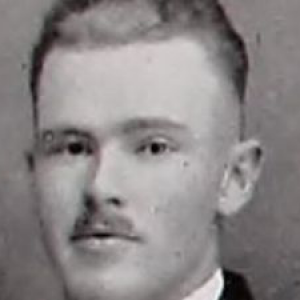
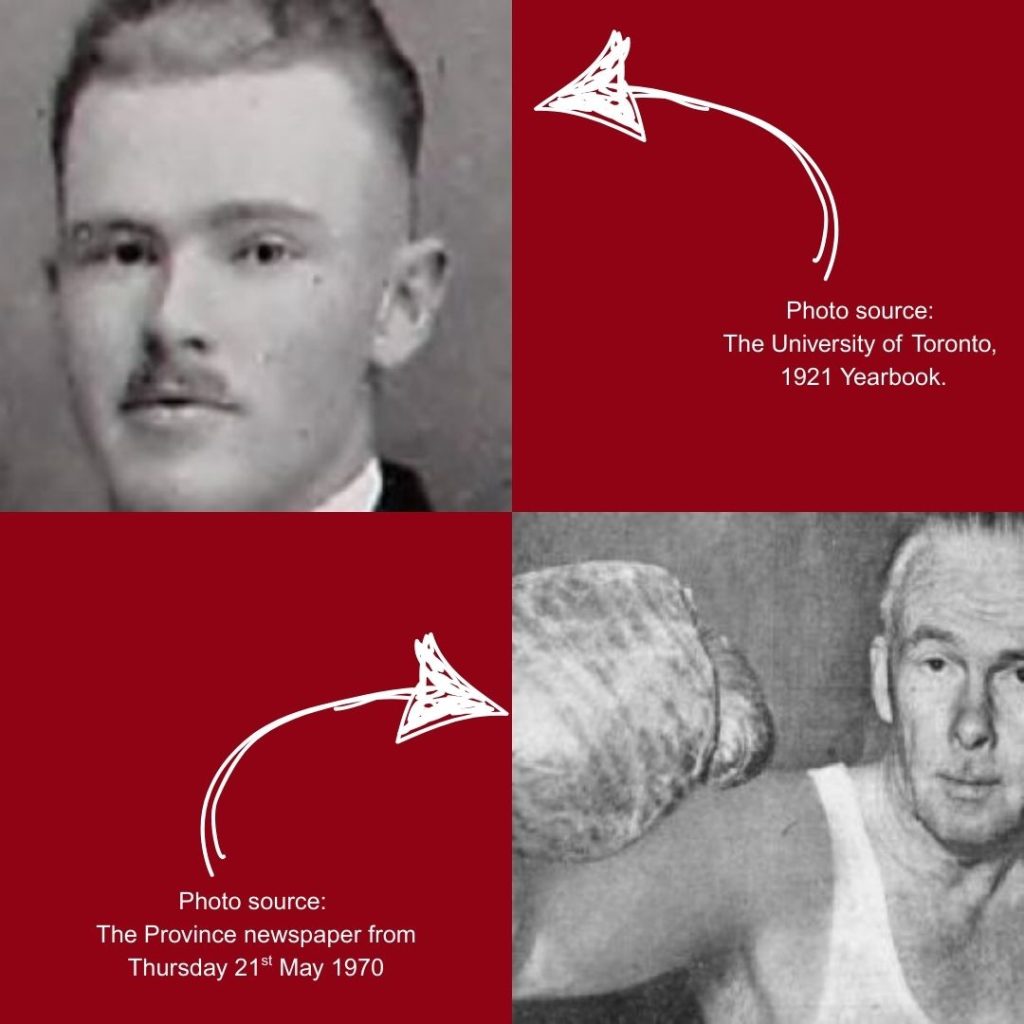
John Knox Affleck. Photo source: The University of Toronto, 1921 yearbook.
Following this we next find Robert and John both were students at the University of Toronto School of Practical Science studying Applied Chemistry [1]. Although, we have found no exact record of when Robert joined the University, we know that John,
“Started at S.P.S with class ’18.”
(The University of Toronto Yearbook 1921).[6]
Therefore, it seems that John started at the University in 1918. We also know that John’s time at the University was interrupted by the World War One.
Signing up
According to John’s service record he attested on 31st March 1916. However, he had already spent two years as a private with the Canadian Officers Training Corps (C.O.P.T) at his university. It actually seems at though John must have been one of the first recruits in the University of Toronto’s C.O.T.C; it only seems to have began there in 1914.
John’s Attestation Paper tell us that he was living in Spadina Avenue in Toronto and was 21 years 9 months old student at the time of enlistment. Another document provides a description of John on enlistment and here we learn that he had auburn hair, brown eyes and was 5ft 5½ Ins tall. John also had a mole on his left jaw and scar on his left knee.
We know he joined the Canadian Overseas Expeditionary Force and was deployed to munitions work.
In November 1916, he was deployed to the o/s Munitions board. Alongside with many other Canadians traveling for war work, John sailed to Liverpool in December 1916. There were three further chemical engineers aboard destined for the Board of Munitions on board during this journey. One of these was a certain Robert Dalton Affleck; John’s brother! Although, we have not come across Robert’s attestation papers, we know he was on the passenger list and can theorise that it is highly likely to be for similar reasons. We’ve come across evidence which suggests that Robert served briefly in the Canadian army prior to this. [7]
H.M. Factory Gretna needed chemists. Both Robert and John had been studying chemistry at university, so it is perhaps unsurprising that they ended up working in munitions.
Indeed, they are not the first people we have come across who were re-directed to work in munitions factory after signing up! The most famous example we have come across so far is probably Australian, Cyril Callister (yes, that is the same Cryil Callister who later invented Vegemite!). After signing up for Australian Imperial Force, Cryil ended up working as a shift chemist at H.M. Factory Gretna.[2]
People came from many Commonwealth countries to work at H.M. Factory Gretna to share their skill, knowledge and more. They had a lasting impact with many of the street names in Eastriggs named after locations in the Commonwealth locations, such as Vancouver Road.
Eastriggs was one of the two townships built to house all the munitions workers that came to work at the factory (the other being the factory’s namesake Gretna, despite the actual nine-mile rural factory site, stretching from Longtown in England to Dornock in Scotland). Gretna Green did exist prior to the factories construction, but there was no running water or electricity until after H.M. Factory Gretna – as it was named in official records – was built.
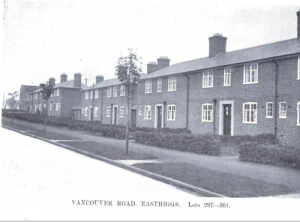
Vancouver Road as shown in an Auction Book from 1924 (when the Factory and townships were sold).
We find it important to remember and the contribution of people who came to work at H.M. Factory Gretna from the Commonwealth and beyond.
Although many of the stories we share focus on are from the past, we now that the varied experience of migration and home across different communities is equally important today. We hope to foster empathy and raise awareness of this by sharing diverse personal narratives through our Exploring the Commonwealth, Migration and Home project.
You can read more about this at the end this blog post and we would love to hear from you if you have migrated from a Commonwealth country or have Commonwealth heritage and would like to share your story.
The Wedding of Robert & Doris
We next come across either of the brothers at a wedding.
On the 30th May 1917, Robert married Doris Conron Smith in the Church of Scotland Annan. Robert is described as a 24 year old chemical engineer, while Doris was the 27 year old daughter of a private tutor.
On 30th May 1917, 24 year old Chemical engineer Robert of 1 Edward Place Annan, married 27 Doris Conron Smith also of 1 Edward Place Annan, daughter of a private tutor. They were married at the Church of Scotland, Annan. One of the two witnesses to the wedding Gladys Thomson, daughter of the minister who interestingly married there three months later.
Intriguingly, we’ve come across evidence of Doris having been to Canada in 1916 (on the passenger list for a later return to Canada). This could of course be purely coincidental, but it would be nice to theorise that Doris and Robert had already met, especially as this took place only six months after Robert arrived. However, we have found no evidence to support this.
Meanwhile what was John up to? Well, John was a witness at his brother’s wedding. He was living at 13-15 The Ridge, Eastriggs [3 & 4] which was a hostel and is a chemical engineer at H.M. Factory Gretna. It seems like Robert would have had a similar job at the factory with his background in applied chemistry.
Following their wedding, Robert and Doris must have moved to Eastriggs, perhaps to be closer to John. Indeed, it seems as though Robert and Doris’ new address was very close to John’s! Robert and Doris were living at 46 The Rand, Eastriggs. We know they still living in this house when their son was born in May 1918.
In 1919, John was listed in the Dornock Farewell Magazine (this was compiled by workers at the Dornock section of H.M. Factory Gretna to remember their time working at the factory) with his home address given as North Bay, Ontario.
Return to Canada
However, on 12th October 1918, Robert, Doris and their son were repatriated on the SS Olympus from Southampton to Canada. John did not return to Canada until March 1919 and he sailed from Liverpool.
Following this we know that John returned to and finished his studies at the University of Toronto. The 1921 University Yearbook features a photo of John with a quote underneath, which reads:
“I winna blaw about mysel’ as ill I like my fauts to tell.”
– University of Toronoto, Yearbook 1921.[6]
It also describes John’s education as:
“Started at S.P.S with class ’18. In war work. Dep’t of Explosive supplies, England. On return joined in with class of ’21.”
– University of Toronto, Yearbook 1921.[6]
We also learn that John attended Mattric at Collegiate Institute, Perth from this yearbook. The 1921 Canadian census describes John as a lodger at Spadina, North Bay and his mother, Jean is the head of the household.
It does not seem as though Robert never did return to his studies like his brother. After he returned in 1918 it seems as though he must have spent some time working lots of different jobs in British Columbia; it seems like this includes two years two years operating a chicken ranch on Gabriola Island.[7]
By 1925, Robert must have decided to make another career changes as it appears that he obtained a teaching certificate. Perhaps he was inspired by his older sister Elise, who worked as a teacher.
After this it appears that Robert spent three years teaching at Hedley, before progressing to Principle at Princeton. During his time at Princeton, it appears that Robert could have also been teaching principles relating to geology to prospector’s and miners as head of a prospector’s club.[7]
Whilst, Robert was embarking on a teaching career, John appears to have continued working as a chemical engineer. It appears as though he could have worked at the Ryerson Institute in Toronto at some point.
The Wedding of John & Jeanne
The year after Robert obtaining a teaching certificate and nearly ten years after his wedding, John married Jeanne Alexander Dingle. The wedding took place on 16th October 1926 at the United Church of Canada, Toronto. John’s occupation is given as a chemical engineer, his address is still the same one in Spadina. Jeanne gave the same address. There is no evidence of Robert being a witness at John’s wedding.
Retirement
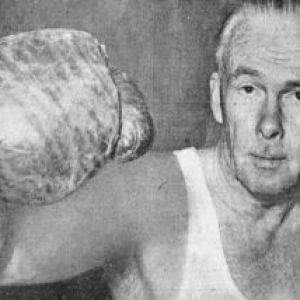
This photo of Robert appeared in The Province newspaper on Thursday 21st May 1970 with him complaining about the forced retirement age. Ultimately, this article came out some time after Robert’s obituary appeared in the same newspaper.
We next find either of the brother’s in 1936. Robert is working as a principle at University Hill in Vancouver. It appears as though Robert stayed in this occupation until he had to retire under legislation at the time at the age of 65 in 1958.
On the 4th May 1970, aged 77 Robert died in Penticton, British Colombia.
The 1972 electoral register shows us that John is now living at Glengarry Avenue, Toronto. Although, he must have retired already, as he is now aged 76, John is still described as a chemical engineer.
In 1988, John died in Toronto. This is four years after his wife Jeanne. Both John and Jeanne are buried at Park Lawn Cemetery Toronto.
Sources & Further Reading
[1] University Roll of Service 1914 – 1918, The University of Toronto, page 170. – https://archive.org/details/universityoftoro00univuoft/universityoftoro00univuoft/page/170/mode/2up
[2] Worker of the Week: Cyril Callister – https://www.devilsporridge.org.uk/cyrilcallister
[3] Eastriggs and Dornock Valuation Roll 1918 to 1919
[4] Eastriggs and Dornock Electoral Roll 1918 to 1919
[5] Robert Dalton Affleck’s Obituary, The Province newspaper, Wednesday May 14th 1970
[6] Yearbook 1921, The University of Toronto
[7]Robert Dalton Affleck’s Obituary, The Province newspaper, Wednesday May 14th 1970
Find John Knox Affleck’s online database entry by clicking here>
Find Robert Dalton Affleck’s online database entry by clicking here>
Do you have a relative who worked at H.M. Factory Gretna? We would love to hear from you! Please feel free to contact us by emailing info@devilsporridge.org.uk. You never know maybe your relative feature in a future Worker of the Week blog post! You can also have a look at some more H.M. Factory Gretna workers on our online database here>
Join our Project: Exploring the Commonwealth, Migration & Home
Currently, The Devil’s Porridge Museum is researching the historical and contemporary factors that drive migration within the Commonwealth nations, exploring personal narratives of migration, and examining the meaning of home through our Commonwealth, Migration and Home project. Our project seeks to foster empathy and awareness of the varied experiences of migration and home across different communities. We are looking for people who have migrated Commonwealth country or have Commonwealth heritage to help us with this project and we would love to hear your story.
By sharing your experiences, you will help create a deeper understanding of migration, identity and home, while contributing to a project that highlights diverse voices and histories. If you would be interested in getting involved in our Commonwealth, Migration and Home Project you can read more by clicking here>